
0

Disc Golf Basics: Essential Tips for Outdoor Fun
Disc golf is winning over parks and playgrounds everywhere. Over 50,000 active tournament players and millions of casual fans are proving this sport is exploding in popularity. Yet most people still think it is just tossing Frisbees in the grass. The real surprise is how disc golf blends strategic thinking with exercise and social connection and it is far more than a casual backyard game.
Table of Contents
- Understanding Disc Golf And Its Appeal
- Essential Gear And Course Layout Explained
- Key Rules And How To Score Points
- Beginner Tips To Improve Your Game
Quick Summary
| Takeaway | Explanation |
|---|---|
| Disc golf is accessible for everyone. | It requires minimal equipment and is easy to learn, making it enjoyable for all ages. |
| Master basic throwing techniques. | Focus on backhand, forehand, and overhead throws to improve your game significantly. |
| Understand scoring and rules. | Knowing how to score and follow disc golf rules enhances competitive play and maintains fair gameplay. |
| Join the disc golf community. | Engage with local leagues and experienced players for feedback and support in your development. |
| Practice continuously to improve. | Regular practice helps reinforce skills and build confidence, leading to better performance on the course. |
Understanding Disc Golf and Its Appeal
Disc golf represents a unique blend of outdoor recreation, athletic skill, and strategic gameplay that has rapidly grown in popularity across the United States. This engaging sport combines elements of traditional golf with the flying dynamics of throwing discs, creating an accessible and enjoyable activity for people of all ages and skill levels.
What Makes Disc Golf Different
Unlike traditional golf, disc golf requires minimal equipment and offers a more affordable entry point for enthusiasts. Players navigate through courses using specialized flying discs instead of golf balls and clubs, aiming to complete each hole with the fewest throws possible. Professional Disc Golf Association reports that the sport has seen a significant surge in participation, with over 50,000 active tournament players and millions of casual participants worldwide.
The game’s appeal lies in its versatility and low barriers to entry. Courses are typically located in public parks, making them easily accessible, and the basic equipment needed is far less expensive compared to traditional golf. According to National Park Service research, disc golf courses provide an excellent way to engage with outdoor spaces while offering a fun, low-impact physical activity.
The Physical and Mental Benefits
Disc golf is more than just a casual pastime. It provides a comprehensive physical workout that engages multiple muscle groups and requires precision, technique, and strategic thinking. Players develop core strength, improve hand-eye coordination, and enjoy cardiovascular exercise while navigating diverse terrains. The mental aspects of the game are equally compelling, demanding focus, problem-solving skills, and the ability to adapt to changing environmental conditions.
The sport also offers significant social benefits. Many players find disc golf to be an excellent way to connect with friends, meet new people, and build community. Courses often become gathering spaces where enthusiasts of all skill levels can share techniques, compete friendly, and enjoy the outdoors together.
For those interested in diving deeper into the nuances of the sport, our comprehensive guide to disc golf rules can help beginners understand the fundamental gameplay mechanics and strategies that make disc golf such an engaging activity.
Whether you’re seeking a new recreational pursuit, a way to stay active, or simply want to explore an exciting outdoor sport, disc golf offers something for everyone. Its combination of accessibility, physical challenge, and social interaction makes it a uniquely appealing activity that continues to attract enthusiasts of all backgrounds.
Essential Gear and Course Layout Explained
Successful disc golf requires understanding both the equipment needed and the intricacies of course design. Players must be equipped with the right tools and knowledge to navigate diverse playing environments effectively.
Disc Selection and Equipment Basics
Every disc golf player needs a strategic collection of discs that serve different purposes. Typically, players carry three primary types of discs: drivers, midrange discs, and putters. Professional Disc Golf Association guidelines recommend beginners start with a basic set of 3-5 discs that cover different flight characteristics.
Drivers are designed for long-distance throws and have sharp, aerodynamic edges that help them travel significant distances. Midrange discs offer more control and accuracy for intermediate shots, while putters are specialized for short, precise throws near the basket. Each disc type has unique weight, plastic composition, and design that influences its flight path and stability.
To help beginners understand the different types of discs and their functions, here’s a summary table outlining the main disc categories and their primary uses in disc golf:
| Disc Type | Main Purpose | Typical Use Case |
|---|---|---|
| Driver | Long-distance throws | Tee shots and long fairways |
| Midrange | Control and accuracy | Approaching the basket |
| Putter | Short, precise throws | Putting and close-range shots |
Understanding Course Layout and Design
Disc golf courses are meticulously designed to challenge players and utilize natural landscapes. According to PDGA Course Design Guidelines, effective course layouts incorporate diverse terrain features like elevation changes, tree obstacles, and strategic hole placements. The typical disc golf course ranges from 9 to 18 holes, with each hole presenting unique throwing challenges.
Course designers carefully consider factors such as hole length, terrain complexity, and player skill levels. A well-designed course provides multiple throwing lanes, requiring players to demonstrate versatility and strategic thinking. Hole lengths can vary dramatically, from short 200-foot technical holes to challenging 800-foot long-distance throws that test a player’s power and precision.
Safety and Course Etiquette
Proper equipment and course knowledge also involve understanding safety protocols and player etiquette. Players should always be aware of their surroundings, wait for others to clear throwing zones, and respect the natural environment. Course maintenance and player responsibility are crucial for preserving disc golf spaces and ensuring a positive experience for all participants.
For players looking to deepen their understanding of disc golf mechanics and terminology, our comprehensive disc golf terminology guide offers valuable insights into the sport’s specialized language and concepts.
Mastering disc golf requires a combination of proper equipment, technical skill, and an understanding of course dynamics. By investing in the right discs, learning course layout principles, and practicing consistently, players can progressively improve their performance and enjoyment of this exciting outdoor sport.
Key Rules and How to Score Points
Disc golf, like traditional golf, follows a structured scoring system that rewards precision, strategy, and consistent performance. Understanding the fundamental rules and scoring mechanics is crucial for players seeking to improve their game and enjoy competitive play.
Basic Scoring Principles
In disc golf, the objective is to complete each hole with the fewest number of throws possible. Professional Disc Golf Association rules specify that players must keep an independent scorecard, recording their throws for each hole throughout the round. Each throw, including penalty throws, is counted towards the player’s total score.
The scoring system is straightforward: the player with the lowest total number of throws at the end of the round wins.
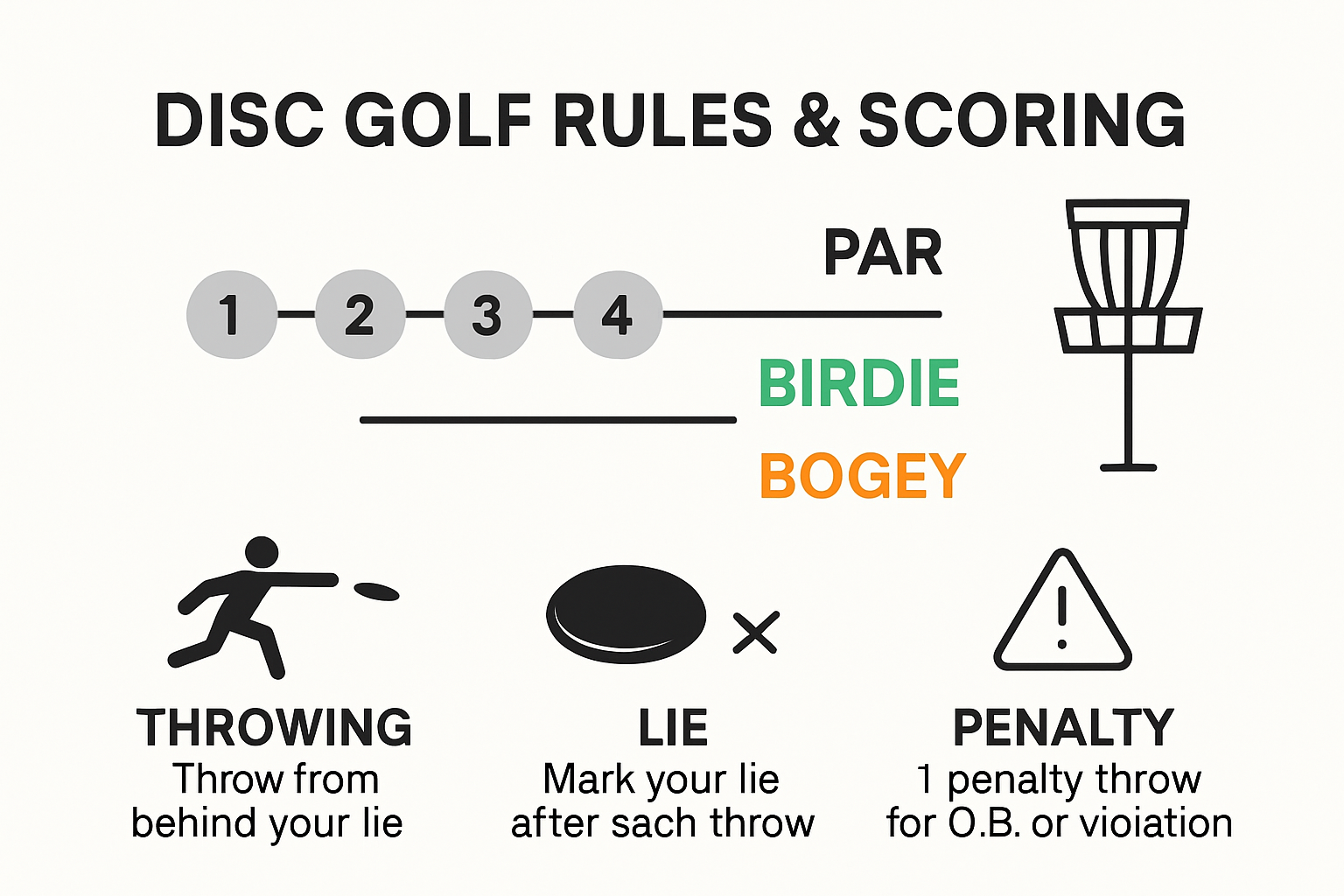
Similar to traditional golf, disc golf courses are typically designed with a predetermined par for each hole, representing the expected number of throws a skilled player would need to complete that hole. Throws under par are considered excellent, while throws over par indicate areas for improvement.
Throwing and Lie Regulations
According to PDGA rule 802.01, a throw is defined as the purposeful propulsion and release of a disc to change its position. Each competitive throw is counted, with specific rules governing player positioning and disc placement. Players must establish their lie, the point from which their next throw will be made, based on where their previous disc landed.
Key throwing regulations include maintaining balance behind the lie when throwing, avoiding stepping past the lie before release, and respecting designated throwing zones. Penalty throws can be assessed for rule violations, such as stepping outside established boundaries or interfering with another player’s throw.
Scoring Variations and Tournament Play
While casual play allows for flexible scoring, competitive disc golf follows more structured guidelines. Tournament play typically uses either stroke play or match play formats. In stroke play, the total number of throws across all holes determines the winner, with the lowest total score claiming victory. Match play involves comparing scores on individual holes, with players winning holes based on relative performance.
For players looking to dive deeper into the nuanced world of disc golf rules, our comprehensive rules guide offers detailed insights into tournament play, scoring intricacies, and advanced gameplay strategies.
Mastering disc golf scoring requires practice, understanding of the rules, and a commitment to continuous improvement. By focusing on technique, learning from each throw, and embracing the sport’s strategic elements, players can progressively enhance their skills and enjoyment of this dynamic outdoor activity.
Beginner Tips to Improve Your Game
Learning disc golf is an exciting journey that combines physical skill, strategic thinking, and continuous improvement. For beginners, developing a solid foundation of techniques and understanding can significantly accelerate their progress and enjoyment of the sport.
Mastering Basic Throwing Techniques
The foundation of disc golf success lies in developing consistent and accurate throwing techniques. Professional Disc Golf Association recommends practicing driving and approach shots in an open field to build muscle memory and improve technique. Beginners should focus on three primary throwing styles: backhand, forehand, and overhead throws.
Below is a comparison table summarizing the three fundamental throwing techniques in disc golf, including basic stance and advantages, as described in the article:
| Throw Type | Basic Stance/Grip | Key Advantage |
|---|---|---|
| Backhand | Sideways to target, smooth release | Most natural and common throw |
| Forehand | Different grip, sideways stance | Versatility for tricky angles |
| Overhead | Over the shoulder | Useful for clearing obstacles |
Backhand throws are the most common and provide a natural motion for most players. Start by standing sideways to the target, with your non-throwing side facing forward. Rotate your body and release the disc with a smooth, fluid motion. Forehand throws require different body positioning and disc grip, offering an alternative approach when backhand throws are challenging. Practicing both techniques provides versatility on the course.
Mental Preparation and Strategy
Mental preparation is as crucial as physical technique in disc golf. PDGA guidelines emphasize building confidence through consistent practice and maintaining a positive mindset. Beginners should set realistic goals, focus on each individual shot, and avoid getting discouraged by challenging holes or missed throws.
Strategy involves more than just throwing technique. Understanding course layout, reading terrain, and selecting appropriate discs for different situations are critical skills. Beginners should practice course management, learning to navigate obstacles, choose throwing lanes, and make strategic decisions about disc selection. Our guide to beginner disc selection can help players choose the right discs to support their developing skills.
Continuous Learning and Community Engagement
Improving in disc golf requires a commitment to continuous learning and practice. Joining local disc golf leagues, participating in casual rounds, and watching experienced players can provide valuable insights. Many experienced players are happy to offer tips and guidance to newcomers.
Avoid common beginner mistakes by being patient with yourself and focusing on gradual improvement. The PDGA warns against setting unrealistic expectations and recommends practicing consistently. Pay attention to your form, seek feedback from more experienced players, and be open to learning from each throw.
Ultimately, disc golf is a journey of personal growth and enjoyment. By focusing on technique, maintaining a positive mindset, and embracing the learning process, beginners can develop their skills and discover the joy of this dynamic outdoor sport. Remember that every professional player started exactly where you are now – with curiosity, enthusiasm, and a willingness to learn.
Frequently Asked Questions
What is the basic objective of disc golf?
The objective of disc golf is to complete each hole in the fewest number of throws possible, similar to traditional golf.
What types of discs do I need to start playing disc golf?
Beginner players typically need three primary types of discs: drivers for long-distance throws, midrange discs for control and accuracy, and putters for short, precise throws near the basket.
How do I improve my throwing technique in disc golf?
To improve your throwing technique, focus on practicing three fundamental throwing styles: backhand, forehand, and overhead throws. Practicing these techniques in an open field can help build muscle memory and improve your overall accuracy and distance.
What are some key rules to remember in disc golf?
Key rules in disc golf include completing each hole with the fewest throws, maintaining your lie (the spot from where you throw next), and respecting the throwing order. Penalty throws may be applied for rule violations, such as stepping beyond your lie before releasing the disc.
Start Your Disc Golf Journey With the Right Equipment
Are you ready to move beyond the basics and see real progress on the course? Many new players get frustrated with inconsistent throws and lack of control. The article discussed the importance of proper disc selection and understanding how different discs impact your game. If you have struggled to find the right drivers, midranges, or putters for your style, finding quality equipment can make all the difference.

Take the next step and explore a wide selection of discs and gear tailored for all skill levels at golfdiscs.com. Whether you need a beginner-friendly driver, an accurate midrange, or a reliable putter, you can find options trusted by players just like you. Do not wait to experience the benefits of well-chosen equipment. Visit our site and discover the tools that help you enjoy every round to the fullest.