
0

Disc Golf Rules Explained: Essential Guide for Players
Did you know that more than 8,000 disc golf courses are open to the public worldwide? Disc golf keeps growing because it invites people of all ages to enjoy friendly competition while exploring the outdoors. Whether you are curious about the equipment, gameplay, or unique rules, understanding how disc golf works helps new and experienced players get the most out of every round.
Table of Contents
- Defining Disc Golf And Core Concepts
- Types Of Discs And Required Equipment
- Standard Rules Of Play And Scoring
- Common Penalties And Infractions Explained
- Essential Disc Golf Etiquette And Safety
Key Takeaways
| Point | Details |
|---|---|
| Game Overview | Disc golf is a unique outdoor sport combining traditional golf principles with specialized flying discs. |
| Disc Types | Players use three main disc types: putters for short throws, mid-range discs for control, and drivers for distance. |
| Rules and Scoring | Scoring is based on minimizing throws, with penalties for out-of-bounds and other infractions impacting gameplay. |
| Etiquette & Safety | Players must prioritize safety and communication, ensuring clear paths and respect for other course users. |
Defining Disc Golf and Core Concepts
Disc golf is an exciting outdoor sport that transforms the classic golf experience into a disc-throwing adventure. According to research from the Understanding the Basics of Disc Golf for Everyone guide, this dynamic game shares fundamental principles with traditional golf but replaces clubs and balls with specialized flying discs.
At its core, disc golf involves players navigating a course and attempting to complete each hole with the fewest possible throws. Players use different types of discs – similar to how golfers use various clubs – and aim to land their disc in a metal basket that serves as the “hole.” The objective remains consistent with ball golf: minimize your total number of throws across the entire course.
The sport officially emerged in the 1970s and has since grown into a globally recognized recreational activity. Key characteristics that make disc golf unique include:
- Accessibility for players of all ages and skill levels
- Lower equipment costs compared to traditional golf
- Ability to play in parks, wooded areas, and dedicated disc golf courses
- Physical and mental challenge of precise disc throwing techniques
For newcomers eager to understand the intricacies of this sport, our Disc Golf Terminology: Key Terms Every Player Should Know guide provides an excellent starting point for learning the essential language and concepts of disc golf.
Types of Discs and Required Equipment
Disc golf requires specialized equipment that goes beyond just throwing a standard frisbee. According to research from How to Choose Disc Golf Discs for Optimal Performance, players utilize three primary disc types, each serving a distinct purpose on the course.
Disc Categories play a critical role in a player’s strategy and performance. There are three main types of discs:
Here’s a comparison of the three main disc types in disc golf:
| Disc Type | Typical Use | Flight Characteristics | Example Distance |
|---|---|---|---|
| Putters | Short, precise throws | Very straight, predictable | 30-60 feet |
| Mid-Range | Moderate/intermediate throws | Good control, balanced speed | 100-250 feet |
| Drivers | Long-distance throws | Fast, less control, max range | 250-400+ feet |
- Putters: Designed for short, precise throws near the basket. These discs fly straight and predictably, helping players make accurate shots when close to the target.
- Mid-Range Discs: Versatile discs used for intermediate distances and more complex shot trajectories. They offer a balance between control and distance.
- Drivers: Specialized discs engineered for maximum distance and speed. They’re typically used for long initial throws to cover substantial course ground.
Beyond disc selection, players need additional essential equipment. Target baskets – metal structures with hanging chains and a basket – serve as the “holes” in disc golf, catching discs when thrown accurately. Most players also carry a disc golf bag to organize and transport their equipment, ensuring they have the right disc for each unique course challenge.
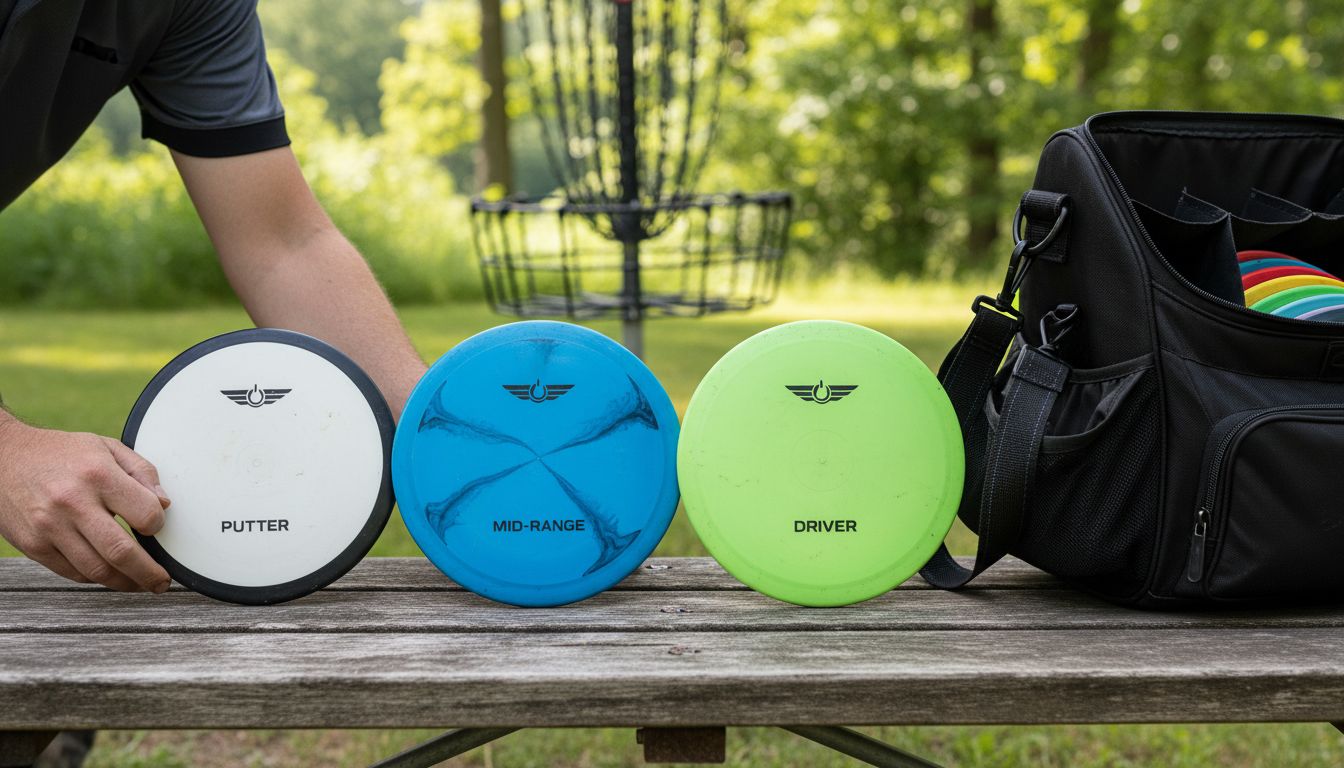
For players looking to optimize their equipment strategy, our How to Organize Your Bag for Disc Golf Success guide offers comprehensive insights into selecting and arranging the perfect disc collection for any skill level.
Standard Rules of Play and Scoring
Disc golf follows a scoring system remarkably similar to traditional golf, with players aiming to complete each course hole in the fewest possible throws. According to research from How is frisbee golf scored, the fundamental objective is straightforward: minimize your total number of strokes across the entire course.
Scoring Basics involve tracking each throw and any potential penalties. One stroke is counted:
- Every time the disc is thrown
- When a penalty is incurred (such as throwing out of bounds)
- Each time a player must take an additional throw due to an unsuccessful attempt
Safety and courtesy are paramount in disc golf. As outlined in research from NTCC, players must ensure the landing area is clear of people, plants, and other potential obstacles before making a throw. Throwing Etiquette requires players to:
- Wait until the path is completely clear
- Communicate with other players on the course
- Respect the natural environment and other course users
To help players navigate the more nuanced aspects of gameplay, our Understanding Mandatory Rules in Disc Golf guide provides comprehensive insights into the finer points of course navigation and rule interpretation. Whether you’re a beginner or looking to refine your understanding, mastering these fundamental rules will enhance your disc golf experience and help you play more confidently.
Common Penalties and Infractions Explained
Understanding penalties is crucial for maintaining fair play in disc golf. According to research from the University of Wisconsin-Parkside, certain specific situations trigger penalties that can impact a player’s overall score and game strategy.
Out-of-Bounds Throws are one of the most common infractions in disc golf. When a disc lands outside the designated playing area, players must:
- Place their next throw at the point where the disc went out of bounds
- Incur a one-stroke penalty
- Throw from a marked spot near the boundary line
Unplayable Disc Positions present another critical penalty scenario. As outlined in Understanding Mandatory Rules in Disc Golf, discs that come to rest more than two meters above ground level are considered unplayable. In such cases, players must:
- Throw from the ground directly beneath the disc’s position
- Add a one-stroke penalty to their score
- Carefully navigate complex terrain to retrieve their disc
Additional common infractions include mandatory line violations, where players must throw their disc on a specific side of designated obstacles, and potential safety-related penalties for throwing without ensuring the landing area is clear. By understanding these rules, players can avoid unnecessary penalties and enjoy a more strategic disc golf experience.
Essential Disc Golf Etiquette and Safety
Safety and respect are paramount in disc golf, creating an enjoyable experience for all players on the course. According to research from Hampton Parks and Recreation, players must prioritize awareness and consideration of their surroundings at all times.
Course Courtesy involves several key principles for maintaining a positive environment. As outlined in the Understanding Disc Golf Etiquette Rules for Players guide, players should:
- Never throw when people, pets, or vehicles are within range
- Give pedestrians and other course users the right of way
- Communicate clearly with other players and groups
- Be patient and allow faster groups to “play through” when necessary
Safety Protocols require players to be proactive and mindful. If people or groups are unknowingly occupying course areas, players should:
- Approach others politely
- Explain the game and potential dangers
- Request they move to a safe location before throwing
- Ensure everyone understands the potential risks of disc golf
By practicing these etiquette guidelines, disc golfers create a safe, respectful, and enjoyable environment for everyone on the course. Mutual understanding and communication are key to preventing accidents and ensuring a positive experience for all players.
Master Disc Golf Rules and Gear Up for Success
Struggling to fully grasp the essential disc golf rules and how they impact your game? This article breaks down the key concepts and common penalties, helping you avoid costly mistakes and play confidently. Understanding terms like out-of-bounds throws, unplayable disc positions, and throwing etiquette can transform your experience from frustrating to rewarding.

Ready to take control of your game and apply these rules with the right equipment? Visit GolfDiscs.com to explore a curated selection of high-quality discs designed for every shot type including putters, mid-range discs, and drivers. Learn how to organize your bag for success with our helpful guides and get the gear that matches your skill level. Don’t wait to elevate your play and enjoy every round to the fullest with Understanding Mandatory Rules in Disc Golf at your side. Start mastering disc golf today by checking out How to Organize Your Bag and choosing your perfect discs now!
Frequently Asked Questions
What are the basic rules of disc golf?
Disc golf rules mirror traditional golf, where players aim to complete each hole in the fewest throws. A stroke is counted every time a disc is thrown or a penalty occurs, such as throwing out of bounds.
What types of discs are used in disc golf?
There are three main types of discs: putters, mid-range discs, and drivers. Putters are used for short, precise throws; mid-range discs are for moderate distances; and drivers are engineered for maximum distance and speed.
What are some common penalties in disc golf?
Common penalties include out-of-bounds throws, where a player incurs a one-stroke penalty and throws from the point the disc went out of bounds, and unplayable disc positions, requiring a one-stroke penalty and a throw from directly beneath the disc.
How can players maintain proper etiquette in disc golf?
Players should prioritize safety and courtesy by never throwing when people are nearby, giving right of way to others on the course, and being patient by allowing faster groups to play through.