
0

How to Putt
You have done all the hard work and arrived on the green. Take out your putter and put it in the basket. Easy as can be, right? Unfortunately putting is not as easy as simply willing the disc into the chains. Putting takes skill and precision and, most importantly, a positive and focused mind. As the saying goes, drive for show and putt for dough. Let’s go!
Grip and Stance
Grab the disc in a way that feels comfortable. Some prefer to put their index finger on the rim while others prefer to grab the disc similar to a drive, with the rim tucked under the first joint of the index finger. Allow the rest of your fingers to rest comfortably and commit to one style. Give your thumb a solid opposing pressure that is not too tight and not too loose. Feel into this. This is important for consistency as you employ other elements of your putt.
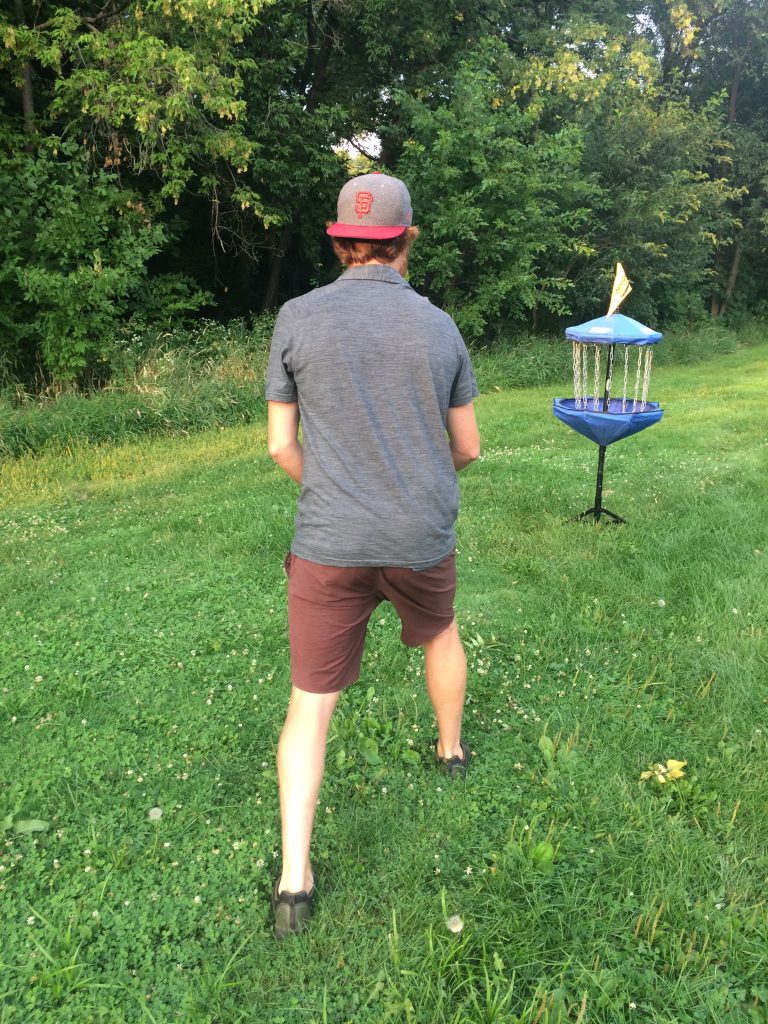
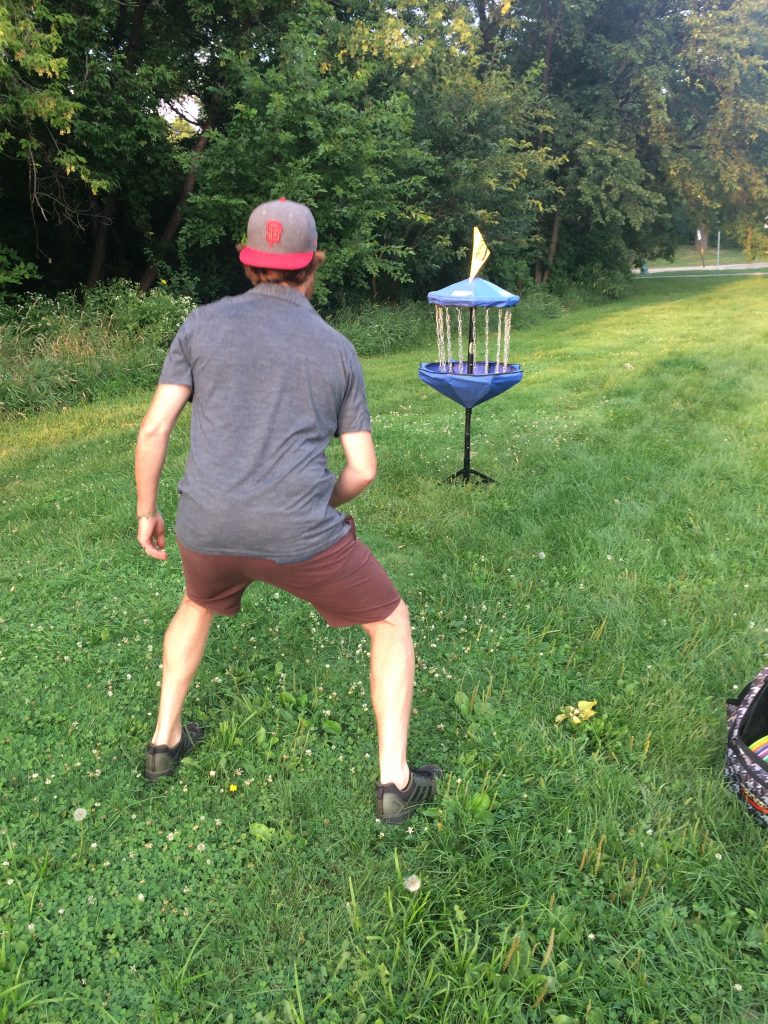
Onto the lower body. There are two types of stances: straddle and stagger. A straddle stance is when you square your body and feet up to the basket. A staggered stance is when you turn your body and feet to an offset position towards the basket. Your feet are lined up one in front of the other with the rear foot offset for balance. Find what is comfortable for you and allow yourself to settle in your stance. Once you are in your stance bring your gaze to the center pole of the basket. Keep your eyes fixed there throughout the entirety of your putt. Be. The. Basket.
Pull Back and Release
Once you have your footwork set and your body aligned, it is time to pull the disc back into your putting-power pocket. This is the place where your body has coiled and has the potential energy to release.
To get into your putting power pocket, move your momentum back and bend your knees. Pick one point on your body to always bring the disc to before exploding towards the basket. For example, in a straddle putt this can be your belly button or anywhere in your midsection. For a staggered putt it can be either hip or wherever feels comfortable. Take a brief moment here, begin to exhale, pop forward with your legs and snap your arm directly at the basket. Think of this movement as a quick stabbing motion. The less movement the better.
As you follow through with your arm reach out directly to the basket. A way to envision this is by shaking hands with the basket with your hand completely outstretched. Finishing your swing in this manner helps with another important aspect of putting: putt THROUGH the basket and not TO the basket. The chains are there to catch your disc and drop it into the basket. You do not need to try to loft your disc and have it land in the basket. Use those chains and you will learn to love their sweet chain music.
(Brief) Rules Section
Upon release your momentum will be moving forward. You must counteract this motion so as not to fall forward inside of 10 meters from the basket. Certain distances from the baskets are referred to as “circles” – e.g., a 10m diameter around the basket defines circle one. Inside of circle one you must hold your stance behind where your disc fell until the disc comes to rest in the basket (or it comes to rest on the ground, ugh!). Outside of circle one you must release the disc behind your lie but you are free to finish forward.
So we need to have a counterweight to hold us in place inside of circle one. For a staggered putt this is done with the rear leg. Upon release lift the rear leg and allow it to counterbalance the forward momentum. Notice how high you hold the leg and what feels comfortable. For a straddle putt use your backside. Upon release the legs pop up and your backside pops back. This can be more difficult to hold your stance but with practice it can be very effective.
Spin Putt vs Push Putt
There are two different types of putts with regard to producing spin out of the hand; spin putt and push putt. A spin putt will have more wrist “snap” and produce more spin. This allows the disc to stay aloft longer and from father distances. This leads to a more consistent stroke from farther distances. One drawback to a spin putt is speed. If you miss hitting the basket the disc will fly much further past the basket for a long comeback putt.
A push putt has less spin and thus limits the speed. Just as the name suggests it is more of a push and has more loft due to less of a wrist “snap.” This putting style can be great for beginners as a miss will still leave you close to the basket.
You can also use a combination of the two called a “spush” putt. This can be very effective when dealing with environmental factors, especially wind and elevation. A head wind will lift the disc and a tail wind will cause the disc to drop. Below is an insightful tutorial into the idiosyncrasies of these two styles.
Mentality
The most important part of putting is your mentality. If you think you will miss the putt, you most likely will. If you think you will make the putt, you most likely will. A good habit to get into when stepping up to take your putt is to simply repeat a mental mantra such as ‘I can” or “Yes.” It may sound a bit ridiculous but trust me, you will make more putts. Take a few seconds before the putt and envision the disc going into the chains, and then do it.
If you have negative thoughts running through your head or the idea “Don’t miss this putt by too far,” take a step away from your putt and regroup. Come back with positivity and take a deep breath as you pull back, exhale, bring your momentum forward and release.
Conclusion
Whatever style you choose for your putt, create a consistent routine leading into it. Commit to your style and make it your own. The best way to learn is by practicing often and staying consistent with your putting style throughout the stroke. Stay positive and you will have the foundation for a dependable putt. No matter what happens off the tee you can always save strokes with your putter. Remember, drive for show and putt for dough!