
0
Mastering Putting Practice Games: Enhance Your Disc Golf Skills
Disc golf putting practice can feel tedious if you just throw discs at a backyard basket. Yet, the right setup can transform practice into something you actually look forward to. Studies show players who integrate structured games and track their progress improve putting accuracy up to 22 percent faster than those who stick to unplanned routines. This might sound like it takes fancy equipment and complicated drills, but it turns out all you need is a portable basket, a handful of discs, and a few clever games to see real, lasting results.
Table of Contents
- Step 1: Gather Essential Putting Equipment
- Step 2: Set Up Your Practice Area
- Step 3: Select Engaging Putting Practice Games
- Step 4: Execute Each Game with Focus
- Step 5: Track Your Progress and Adjust Games
Quick Summary
| Key Point | Explanation |
|---|---|
| 1. Assemble essential putting equipment | Gather a portable disc golf basket and 3-5 identical putting discs for effective practice sessions. |
| 2. Set up a strategic practice area | Choose a flat, open space with minimal obstacles to simulate real disc golf conditions. |
| 3. Engage in varied putting games | Use games like P-U-T-T and 7 on the Line to enhance skills while keeping practice enjoyable. |
| 4. Execute games with mental focus | Develop a pre-shot routine and concentrate on external targets for improved performance. |
| 5. Track progress and adjust as needed | Monitor your success metrics and set incremental goals to continually improve your putting skills. |
Step 1: Gather Essential Putting Equipment
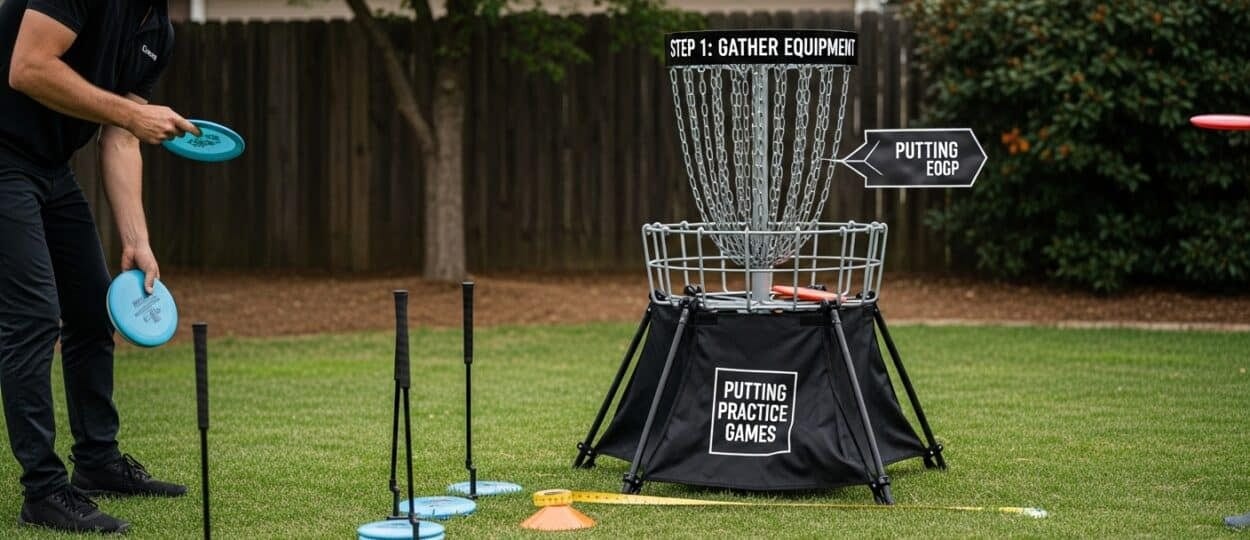
Successful disc golf putting practice starts with having the right equipment. Before diving into exciting putting games, you need to assemble some essential tools that will transform your backyard into a dynamic training zone. The primary requirement is a portable disc golf basket which serves as your primary target and enables versatile practice sessions.
When selecting your putting basket, focus on portability and durability. Look for lightweight models that can be easily transported between locations like your backyard, local park, or even a beach setting. Professional-grade portable baskets typically feature sturdy metal chains and a compact base that allows quick setup and breakdown. Some baskets come with adjustable height settings, which can help simulate different course conditions and challenge your putting skills progressively.
In addition to a basket, you will need a set of putting discs. Most disc golfers recommend having 3-5 identical putters for consistent practice. These discs should have a comfortable grip and predictable flight pattern. Explore our guide on choosing the right putt and approach disc to understand the nuanced characteristics that make a great putting disc. Pay attention to factors like disc weight, plastic type, and rim design when making your selection.
To create a comprehensive putting practice environment, consider additional optional equipment that can enhance your training:
- Marking cones or discs to establish putting distances
- A measuring tape to set precise practice ranges
- A small towel for cleaning discs and maintaining grip
- Weather-appropriate clothing that allows free movement
While professional-grade equipment can be helpful, remember that creativity and consistent practice matter more than having the most expensive gear. Your backyard can become an excellent training ground with just a basket, a few putters, and a commitment to improving your skills. As you progress, you can gradually invest in more specialized equipment to refine your technique.
Verify your equipment readiness by checking that your basket is stable, your putters are in good condition, and you have a clear, unobstructed practice area. With these essentials in place, you are now prepared to explore the engaging putting practice games that will elevate your disc golf performance.
Here is a quick-reference table detailing essential and optional tools needed for effective disc golf putting practice, along with their purposes.
| Equipment | Required/Optional | Purpose |
|---|---|---|
| Portable disc golf basket | Required | Provides a realistic target for putting practice |
| 3-5 identical putting discs | Required | Ensures consistent grip and flight for skill development |
| Marking cones or discs | Optional | Used to set and identify different putting distances |
| Measuring tape | Optional | Measures precise distances for varied practice |
| Towel | Optional | Keeps discs clean and enhances grip |
| Weather-appropriate clothing | Optional | Allows for comfortable movement during practice |
Step 2: Set Up Your Practice Area
Creating an effective putting practice zone requires strategic planning and thoughtful spatial arrangement. Your practice area will serve as the training ground where you transform basic skills into precise, consistent putting techniques. The goal is to design a space that mimics real disc golf course conditions while providing enough flexibility for various putting practice games.
Begin by selecting a suitable location with ample open space and minimal obstacles. Your backyard, a local park, or a spacious outdoor area works perfectly. Aim for a flat surface that provides stable footing and allows your portable basket to stand securely. Ideally, choose a spot with minimal wind interference and enough room to move around freely. The recommended practice area should provide at least 20-30 feet of clear space in multiple directions, enabling you to practice putting from different angles and distances.
Position your portable disc golf basket as the central focus of your practice zone. Learn more about optimal course design techniques to understand how professional disc golfers set up their training environments. Ensure the basket is placed on stable ground, with its chains hanging freely to simulate authentic course conditions. Use marking cones or ground markers to establish consistent putting distances and create structured practice zones. These markers help you track your progress and maintain disciplined throwing techniques.
Consider the following elements when setting up your practice area:
- Soft ground surface like grass for comfortable stance
- Clear line of sight to the basket
- Minimal breakable objects or valuable property nearby
- Potential for multiple putting angles and distances
Vary your practice environment periodically to challenge yourself. This might mean adjusting basket placement, introducing elevation changes, or practicing on slightly uneven terrain. Such variations prevent your muscle memory from becoming too rigid and prepare you for the unpredictable conditions of actual disc golf courses.
Verify your practice area is ready by walking through the space, checking for potential hazards, ensuring smooth disc flight paths, and confirming that your portable basket is stable and correctly positioned. A well-designed practice zone sets the foundation for engaging putting games and consistent skill improvement.
Step 3: Select Engaging Putting Practice Games
Transforming putting practice from a monotonous routine into an exciting challenge requires selecting the right games that keep you motivated and continuously improve your skills. The key is to choose putting practice games that not only test your accuracy but also make the learning process enjoyable and dynamic.
Start with fundamental putting games that progressively increase in complexity. P-U-T-T is an excellent initial game that helps build consistency and precision. In this game, each letter of PUTT represents a different putting challenge. Players must successfully make a putt for each letter, with increasingly difficult distances or angle requirements. For instance, the “P” might represent a close-range putt, while “T” could demand a more challenging angled shot. This game transforms practice into a strategic spelling challenge that keeps players engaged and focused.
Check out our practice basket options to support your putting game setup. The “7 on the Line” game offers another fantastic approach to skill development. This game requires players to successfully make seven consecutive putts from a specific distance before advancing to the next marker. It builds mental resilience and muscle memory by demanding consistent performance under mild pressure. The game can be adapted for solo practice or competitive group sessions, making it versatile for different skill levels and practice environments.
Consider these variations to keep your putting practice dynamic:
- Introduce obstacles or wind conditions to simulate real course challenges
- Change putting distances randomly to prevent predictable muscle memory
- Alternate between different putting techniques like straddle and jump putting
As research from disc golf educational programs suggests, games that combine skill development with enjoyment are most effective in maintaining long-term practice motivation. The goal is to create an environment where improvement feels like play rather than work.
Verify your game selection’s effectiveness by tracking your success rates, noting improvements in accuracy, and ensuring you remain excited about your practice sessions.
This table organizes popular disc golf putting practice games mentioned in the article, highlighting their main features and skill benefits for easy comparison.
| Game Name | Main Feature | Skill Focus |
|---|---|---|
| P-U-T-T | Make putts for each letter, increasing difficulty with each | Consistency and precision |
| 7 on the Line | Seven consecutive putts required before moving distance | Mental resilience, accuracy |
| Obstacles/Wind | Adding obstacles or simulating wind for realistic challenge | Adaptability and focus |
| Distance Change | Randomly changing putting distances to avoid routine | Versatility, muscle memory |
| Technique Switch | Alternating putting styles (straddle, jump) | Technique diversity |
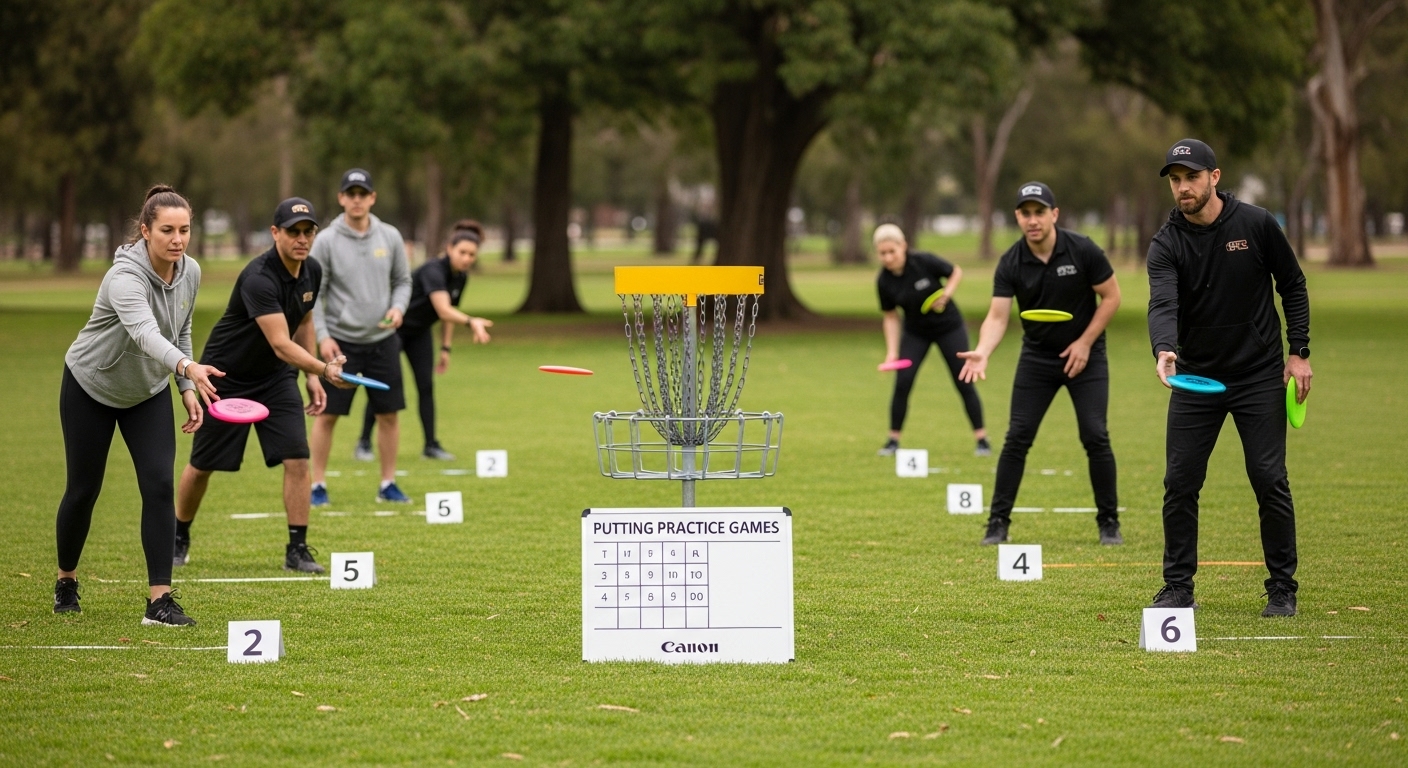
Step 4: Execute Each Game with Focus
Executing putting practice games requires more than just physical technique – it demands mental discipline and strategic attention. Deliberate focus transforms routine throwing into a powerful skill-building experience that translates directly to improved disc golf performance. The key is developing a consistent mental approach that combines technical precision with psychological preparation.
Before each putting attempt, establish a reliable pre-shot routine that centers your mind and body. According to research from Sonoma State University, maintaining a rhythm-based focus can significantly enhance putting accuracy. This means developing a consistent sequence of actions: approach the basket, take a deep breath, visualize the disc’s trajectory, and maintain a relaxed but purposeful stance. Your pre-shot routine should become second nature, creating muscle memory and reducing performance anxiety.
When executing putting games like P-U-T-T or 7 on the Line, concentrate on external targets rather than internal body mechanics. Fixate on the basket’s chains or a specific point within the basket opening. This external focus helps your body naturally calibrate the throwing motion without overthinking technical details. Pay attention to your grip pressure, ensuring it remains consistent but not rigid. A relaxed grip allows for smoother release and more predictable disc flight.
Consider these mental strategies to enhance your putting game execution:
- Maintain a positive internal dialogue
- Breathe deeply to reduce tension
- Reset mentally after each throw, regardless of success
- Treat each putt as an independent opportunity
Variability is crucial in maintaining engagement and preventing mental fatigue. Alternate between different putting styles, change distances, and introduce subtle challenges that keep your practice sessions dynamic. This approach prevents your practice from becoming a repetitive, monotonous activity and ensures continuous skill development.
Verify your execution’s effectiveness by tracking several key indicators: consistency of release, accuracy percentage, mental composure during challenging throws, and overall comfort with different putting scenarios. Success isn’t just about making every putt, but about developing a reliable, repeatable technique that holds up under various conditions.
Step 5: Track Your Progress and Adjust Games
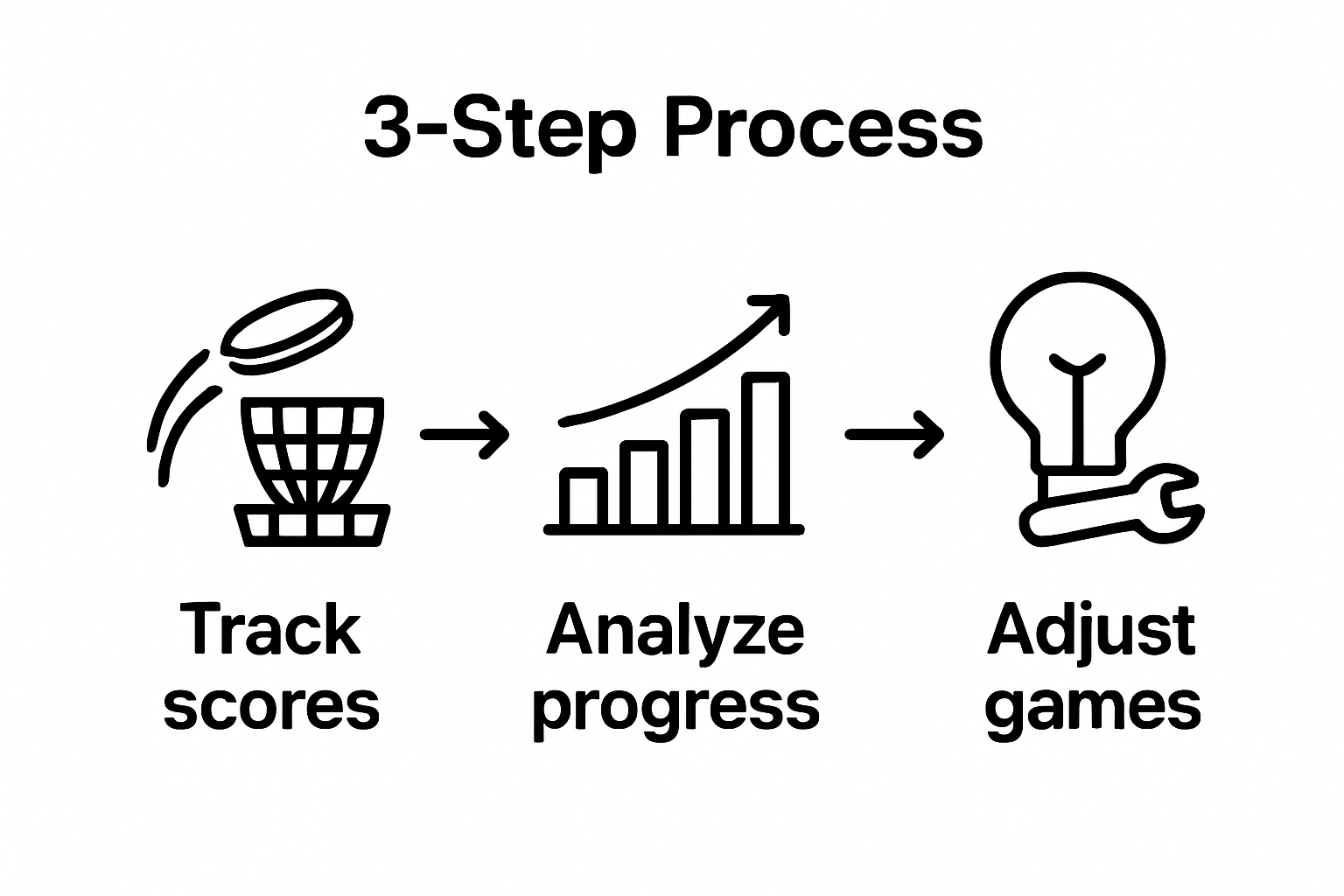
Transforming putting practice from random throwing to strategic skill development requires systematic progress tracking. Intentional measurement transforms your practice from guesswork into a targeted improvement journey, allowing you to understand your strengths, identify weaknesses, and make data-driven adjustments to your putting games.
Begin by establishing baseline metrics for each putting practice game. For the P-U-T-T game, record your initial success rate for each letter challenge, noting the distances and angles that prove most challenging. Create a simple tracking sheet or use a dedicated mobile app to document your performance. Learn more about performance tracking techniques to refine your approach. Consistent documentation enables you to visualize your progression and maintain motivation through tangible evidence of improvement.
According to research in sports psychology, self-monitoring paired with structured feedback significantly enhances skill acquisition. Apply this principle by setting incremental goals for each putting practice game. Instead of aiming for perfection immediately, focus on small, achievable improvements. For instance, in the 7 on the Line game, challenge yourself to increase your consecutive successful putts by one or two each week.
Consider these strategic tracking and adjustment methods:
- Use video recording to analyze your putting technique
- Compare performance across different practice sessions
- Rotate between various putting distances and angles
- Introduce minor variations to prevent muscle memory stagnation
Mental adaptation is as crucial as physical skill development. When you notice consistent challenges in specific putting scenarios, design targeted mini-games that address those weaknesses. If long-distance putts consistently challenge you, create practice scenarios that emphasize those specific shots. The goal is to transform perceived limitations into opportunities for deliberate skill enhancement.
Verify your progress tracking’s effectiveness by ensuring your documentation is consistent, your goals are realistic and incrementally challenging, and you maintain a positive, growth-oriented mindset. Success in disc golf putting practice isn’t about achieving perfection overnight, but about committed, strategic improvement that builds confidence and skill with each throw.
Take the Next Step: Turn Your Backyard Practice Into Real Disc Golf Success
You have put in the effort to set up your putting practice area and immerse yourself in proven games like P-U-T-T and 7 on the Line. Maybe you have faced frustrations with inconsistent discs, unstable baskets, or trouble keeping your skills sharp at home. We understand how much dedication it takes to overcome these challenges and build true disc golf confidence. Whether you want to upgrade your portable basket, add reliable putters, or track your progress with quality gear, your journey deserves top-tier equipment.

Why settle for anything less than the best foundation for your practice sessions? Browse our expert-selected collection of practice baskets and essential putting gear built for home and travel. If you are looking for guidance on perfecting your putt, our comprehensive putt and approach disc guide makes choosing the right disc simple and effective. Visit golfdiscs.com now to find the equipment that keeps you motivated and moving forward. Make today the day you transform practice into lasting disc golf performance.
Frequently Asked Questions
What equipment do I need for disc golf putting practice?
To effectively practice putting in disc golf, you will need a portable disc golf basket and a set of 3-5 identical putting discs. Optional equipment includes marking cones, a measuring tape, and a small towel for maintaining grip.
How can I set up a practice area for putting?
Choose a flat, open location with at least 20-30 feet of clear space around your portable basket. Ensure minimal obstacles and wind interference to replicate real course conditions. Use markers to establish putting distances and improve consistency during practice.
What are some engaging putting practice games I can try?
You can try games like P-U-T-T, where each letter represents a different putting challenge, or 7 on the Line, which requires making seven consecutive putts from a specific distance. Varying your practice routine and introducing obstacles can also keep practice engaging.
How do I track my progress in putting practice games?
Establish baseline metrics for each game you play, noting success rates, distances, and challenges faced. Document your performance over time to visualize progress, and set incremental goals to enhance your skills systematically.