
0

Understanding Disc Golf Fairways Explained Simply
Disc golf courses are full of surprises, but nothing shapes a round more than the fairways themselves. Some fairways are so tight and lined with trees that even expert players feel the pressure, while others open up to vast meadows that change the entire pace of play. The twist is that well-designed fairways can turn even a flat, simple park into a fierce mental and physical challenge for every player on the course.
Table of Contents
- Defining Disc Golf Fairways And Their Role
- The Importance Of Fairways In Disc Golf
- The Structure Of Fairways: Key Elements
- How Fairway Design Influences Gameplay
- Real-World Examples Of Various Fairways
Quick Summary
| Takeaway | Explanation |
|---|---|
| Fairways define the gameplay path | Fairways guide players from the tee to the basket, presenting unique strategic challenges. |
| Precision is key on narrow fairways | Tight fairways require accurate disc placement and careful shot selection to navigate successfully. |
| Course design affects player strategy | The layout of fairways influences decision-making, requiring adaptive thinking and problem-solving skills. |
| Environmental factors complicate play | Terrain variations and natural obstacles challenge players to adjust their techniques and strategies during rounds. |
| Skill development occurs through fairway navigation | Different fairway types present opportunities for enhancing throwing skills and understanding disc dynamics. |
Defining Disc Golf Fairways and Their Role
In disc golf, fairways represent the primary playing path between the tee area and the basket, serving as the designated route players navigate to complete each hole. These corridors of play are crucial elements that define the strategic challenge and technical complexity of disc golf courses.
The Fundamental Structure of Fairways
Fairways are typically narrow corridors lined with trees, bushes, or other natural obstacles that create a defined path for disc flight. Unlike traditional golf, disc golf fairways can vary dramatically in width, shape, and terrain. Some fairways might be wide and open, allowing multiple throwing lines, while others are tight and technical, requiring precise disc control and strategic shot selection.
A well-designed fairway challenges players by:
- Requiring accurate disc placement
- Testing throwing skills and disc control
- Creating strategic decision points about throw trajectory
- Presenting multiple potential routes to the basket
Strategic Importance in Course Design
Course designers use fairways to create unique challenges that test a player’s skill, creativity, and adaptability. Fairway design principles are critical in determining the overall difficulty and enjoyment of a disc golf course. By carefully positioning trees, incorporating elevation changes, and creating strategic bottlenecks, designers can transform a simple path into a complex puzzle that demands thoughtful navigation.
Understanding fairways is not just about knowing the physical path, but comprehending how different disc types, throwing techniques, and environmental conditions interact within these designated playing corridors. Skilled players learn to read fairways like strategic maps, planning multiple potential routes and anticipating potential obstacles before releasing their disc.
The Importance of Fairways in Disc Golf
Fairways are more than simple paths between tee and basket. They represent the fundamental architectural and strategic core of disc golf course design, creating a complex landscape that tests a player’s skills, decision making, and technical ability.
Skill Development and Performance Challenges
Fairways serve as critical training grounds for disc golfers, offering unique opportunities to develop throwing precision and strategic thinking. Each fairway presents a distinct set of challenges that require players to adapt their techniques, disc selection, and throwing approach. Fairway drivers become essential tools in navigating these intricate playing corridors.
Players must develop multiple skills through fairway navigation:
- Accurate disc placement
- Understanding disc flight characteristics
- Reading terrain and obstacle interactions
- Developing mental strategy and course management
Course Design Philosophy
Disc golf course designers use fairways as primary instruments for creating engaging and challenging playing experiences. By manipulating fairway width, incorporating natural obstacles, and utilizing terrain variations, designers transform simple landscapes into complex athletic puzzles. A well-designed fairway demands more than physical skill it requires creative problem solving and adaptive thinking.
The strategic complexity of fairways means that no two disc golf courses are identical. Each fairway becomes a unique challenge that tests a player’s technical skills, mental flexibility, and ability to read and respond to environmental conditions. Experienced players understand that mastering fairways is about more than throwing technique it’s about developing a holistic approach to disc golf as both a physical and strategic sport.
The Structure of Fairways: Key Elements
Disc golf fairways are complex spatial environments that combine natural terrain, strategic design elements, and specific physical characteristics. Understanding their intricate structure helps players develop more sophisticated navigation and throwing techniques.
Geometric and Physical Components
Fairway dimensions vary significantly across different courses, creating unique challenges for players. The width, length, and overall shape of a fairway directly impact throwing strategies and disc selection. Narrow fairways demand precision, while wider paths allow more throwing options. Flight paths become critical in navigating these complex spatial corridors.
Key structural elements of fairways include:
- Horizontal corridor width
- Vertical clearance between obstacles
- Ground terrain and elevation changes
- Natural and artificial obstacles
- Directional curvature
Environmental Interaction Zones
Fairways are not static environments but dynamic interaction zones between player, disc, and landscape. They incorporate multiple environmental factors that influence disc flight and player strategy. Terrain variations such as slopes, uneven ground, and vegetation density create additional complexity beyond simple linear pathways.
Advanced fairway structures challenge players by introducing:
- Mandatory flight windows
- Strategic obstacle placement
- Intentional trajectory constraints
- Punishment zones for errant throws
- Multiple potential throwing lines
The sophisticated design of fairways transforms disc golf from a simple throwing game into a nuanced spatial problem solving experience, where technical skill meets environmental intelligence.
How Fairway Design Influences Gameplay
Fairway design is a critical element that transforms disc golf from a simple throwing exercise into a sophisticated strategic experience. By carefully manipulating physical landscapes and potential disc trajectories, course designers create complex challenges that test players mental and physical capabilities.
Strategic Decision Making
Fairway complexity directly impacts player decision making, requiring constant adaptation and creative problem solving. Players must rapidly assess multiple potential throwing lines, anticipate disc behavior, and select strategies that maximize scoring potential. Research on disc golf course development indicates that sophisticated fairway design can significantly increase cognitive engagement during gameplay.
Key strategic considerations include:
- Selecting appropriate disc type
- Analyzing potential throwing lines
- Estimating risk versus reward
- Anticipating disc flight characteristics
- Managing environmental variables
Physical and Mental Challenges
Fairway design introduces multifaceted challenges that extend beyond simple throwing mechanics. Elevation changes, dense vegetation, and strategic obstacle placement force players to develop advanced spatial reasoning skills. Each fairway becomes a unique puzzle that demands precision, creativity, and adaptability.
Advanced players recognize that successful navigation requires:
- Precise disc control
- Understanding wind interactions
- Reading terrain subtleties
- Developing mental resilience
- Continuous technique refinement
The intricate relationship between fairway design and player performance transforms disc golf into a dynamic, intellectually engaging sport where physical skill meets strategic thinking.
Real-World Examples of Various Fairways
Disc golf fairways showcase remarkable diversity, reflecting the unique landscapes and creative design philosophies of different courses. Each fairway represents a distinct challenge, transforming natural terrain into strategic playing environments that test players’ skills and adaptability.
Forest and Woodland Fairways
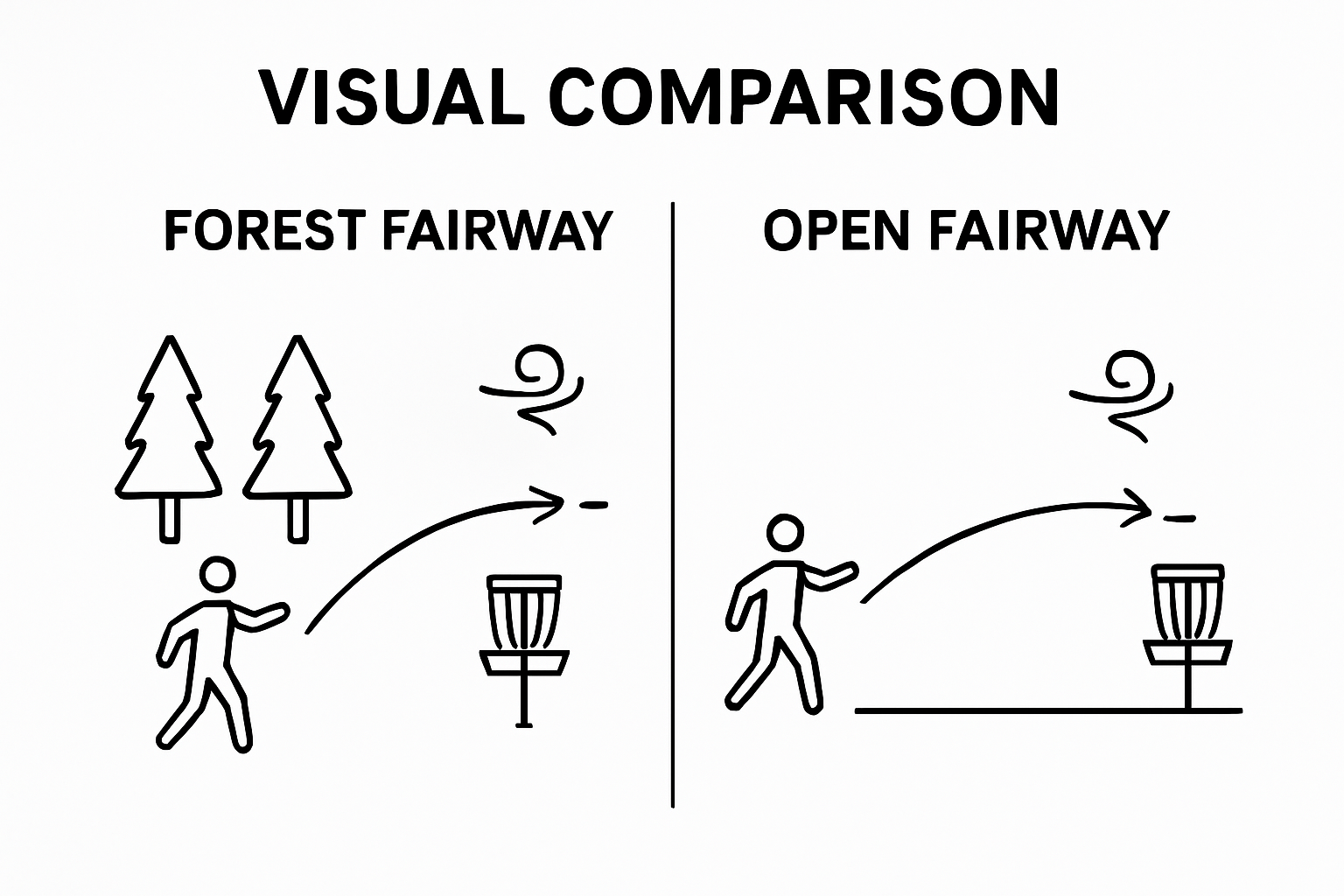
Dense forest fairways create some of the most technically demanding disc golf experiences. These narrow corridors wind through thick tree lines, requiring pinpoint disc control and sophisticated throwing techniques. Course redesign strategies often leverage existing woodland landscapes to create intricate playing paths that challenge even experienced players.
Characteristics of woodland fairways include:

- Extremely narrow throwing lanes
- Constant elevation changes
- Multiple mandatory flight paths
- High technical skill requirements
- Significant obstacle density
Open Terrain and Meadow Fairways
Contrasting forest environments, open terrain fairways provide expansive playing spaces that demand different strategic approaches. Wide fairways allow multiple disc trajectory options, encouraging players to experiment with throwing techniques and disc selection. These environments test a player’s ability to manage wind conditions and predict long-distance disc flight paths.
Open terrain fairway challenges include:
- Managing wind interference
- Selecting optimal disc types
- Calculating precise throwing angles
- Understanding extended flight characteristics
- Navigating subtle terrain variations
The diversity of fairway designs transforms disc golf from a simple throwing game into a complex, engaging sport that celebrates both natural landscapes and human creativity.
Below is a comparison table outlining the distinct features and strategic challenges of forest/woodland fairways versus open terrain/meadow fairways as discussed in the article.
| Fairway Type | Defining Characteristics | Strategic Challenges |
|---|---|---|
| Forest/Woodland | Narrow, tree-lined, technical; frequent elevation changes | Requires advanced disc control, precise placement, and handling dense obstacles |
| Open Terrain/Meadow | Wide, spacious, open visibility; subtle terrain differences | Demands wind management, long-distance accuracy, and optimal disc selection |
Ready to Conquer Any Disc Golf Fairway?
Reading about disc golf fairways has probably made you realize just how much skill and the right equipment matter. Maybe you struggle to find discs that truly match the challenges of tight fairways, changing terrain, or tricky flight paths. It is easy to feel limited by generic gear when every fairway requires such precise control, flexibility, and strategy. What if you could find exactly the discs and tools that help you conquer any fairway from open meadows to dense woods? The key is understanding your own play style and matching it to high-quality discs specifically designed for every type of fairway you face.

Do not let frustration hold back your game. Upgrade your bag with expert-selected discs and equipment from GolfDiscs.com. Whether you need to master fairway drivers for narrow corridors or want inspiration for building a more strategic game, we have you covered. Take your skills further by discovering game-changing gear and advice so you can start mastering any fairway now. Browse our selection and shop the trusted source trusted by disc golfers everywhere.
Frequently Asked Questions
What are disc golf fairways?
Disc golf fairways are the designated pathways between the tee area and the basket, often lined with natural obstacles. They are essential for defining the strategic challenges of a disc golf course.
How do fairways impact gameplay in disc golf?
Fairways influence gameplay by requiring players to make strategic decisions regarding shot selection and disc control, as they may vary in width, shape, and complexity, presenting unique challenges on each hole.
What skills do players develop while navigating fairways?
Players develop a range of skills, including accurate disc placement, understanding disc flight characteristics, reading terrain interactions, and enhancing their mental strategy and course management abilities.
Why are fairway design principles important in disc golf courses?
Fairway design principles are crucial because they affect the overall difficulty and enjoyment of a course, shaping how players approach each hole and testing their skills, creativity, and adaptability.