
0

Understanding Understable vs Overstable Discs in Disc Golf
Disc golf is not just about throwing a frisbee through the woods. The secret sauce lies in knowing what makes a disc fly left, right, or laser-straight down the fairway. Most beginners reach for any disc and hope for the best but research actually shows that new players get better results with understable discs, which are more forgiving and easier to control. That flips the script on what most people expect and makes your choice of disc stability way more important than you might think.
Table of Contents
- What Are Understable and Overstable Discs?
- Why Does Stability Matter In Disc Golf?
- How Disc Stability Influences Flight Paths
- Key Characteristics Of Understable And Overstable Discs
- Choosing The Right Disc For Your Game
Quick Summary
| Takeaway | Explanation |
|---|---|
| Understand disc stability types | Knowing the difference between understable, stable, and overstable discs helps enhance your game. |
| Choose discs based on skill level | Beginners should use understable discs while advanced players benefit from overstable options for precision. |
| Disc stability influences shot shaping | Selecting the right disc type allows players to predict disc behavior and navigate course challenges effectively. |
| Experiment with disc selection | Players should test various discs to find those that complement their throwing style and conditions. |
| Pay attention to environmental factors | Wind and terrain can affect disc flight; understanding stability helps adapt shots to these conditions. |
What Are Understable and Overstable Discs?
In disc golf, understanding disc stability is crucial for players seeking precision and control. Understanding disc stability requires recognizing how different discs behave during flight based on their design and aerodynamic properties.
Flight Characteristics and Stability Spectrum
Disc stability describes how a disc travels through the air and its tendency to curve during different phases of flight. The stability spectrum ranges from understable to stable to overstable, with each type exhibiting unique flight characteristics
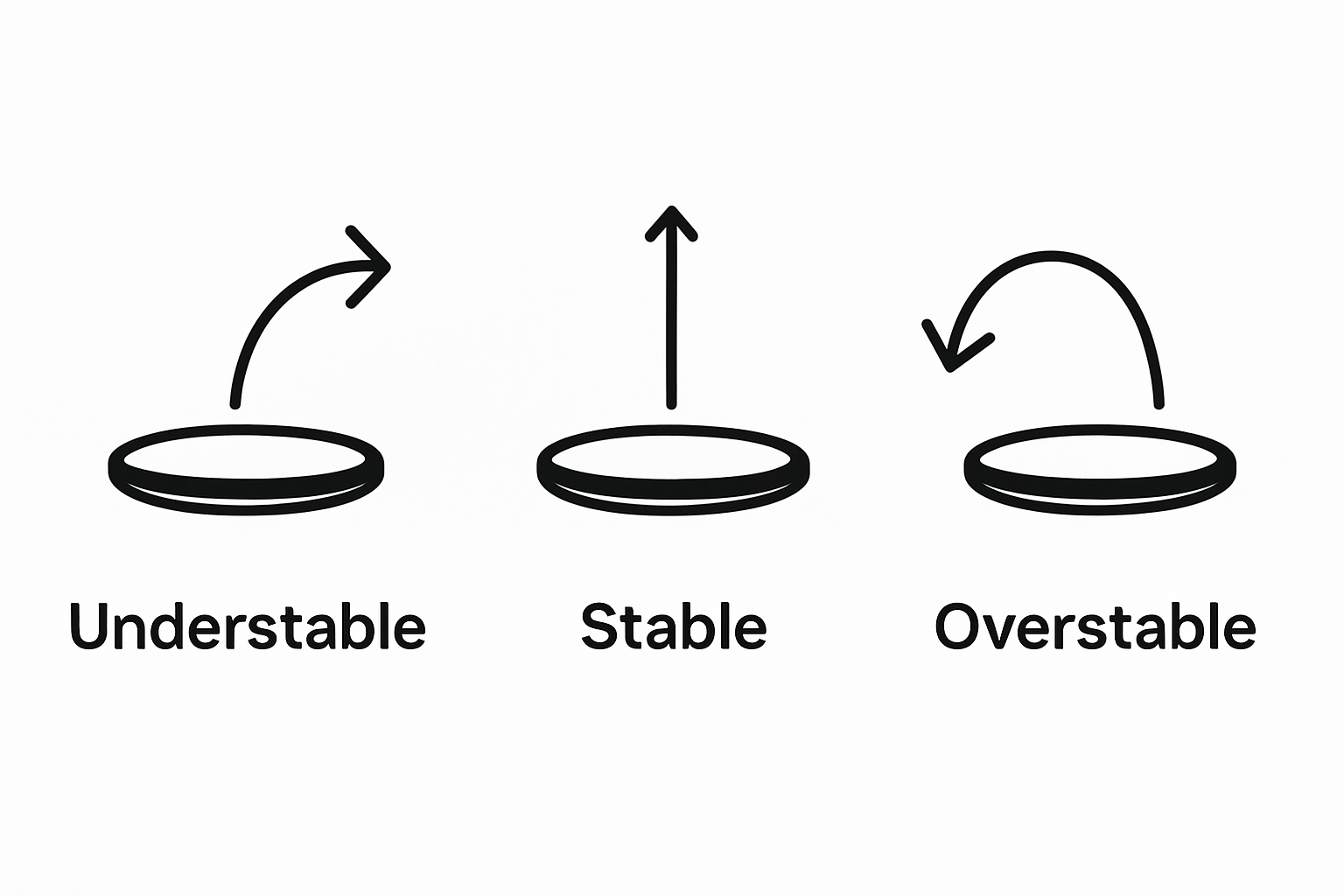 :
:
- Understable Discs: These discs naturally turn right for right-handed backhand throws, creating an easy turning motion during high-speed portions of the flight.
- Stable Discs: These discs maintain a relatively straight trajectory, experiencing minimal turning or fading.
- Overstable Discs: These discs consistently fade left for right-handed backhand throws, demonstrating more predictable and aggressive ending movements.
Physics Behind Disc Stability
According to research from disc physics experts, disc stability results from complex aerodynamic interactions. When thrown, discs experience different forces that influence their trajectory. Understable discs are more sensitive to throwing speed and release angle, often exhibiting more dramatic turning motions. Overstable discs, conversely, resist turning and have a stronger tendency to fade consistently.
Understanding these nuanced flight characteristics allows players to select discs that complement their throwing style and the specific demands of different course layouts.
To help you quickly compare how understable, stable, and overstable discs behave, the following table summarizes their core flight characteristics for right-handed backhand throws.
| Disc Stability Type | Typical Flight Path (RHBH) | Turn Tendency | Fade Strength | Player Suitability |
|---|---|---|---|---|
| Understable | Turns right | High | Low | Beginners, controlled long shots |
| Stable | Stays straight | Minimal | Minimal | All levels, straight approach |
| Overstable | Fades left | Low | High | Advanced, windy conditions, fades |
| Beginners typically benefit from more understable discs, which provide greater forgiveness and easier control, while advanced players often prefer overstable discs for precise shot-shaping and predictable fade. |
Why Does Stability Matter in Disc Golf?
Stability in disc golf is not just a technical term but a critical factor that determines a player’s performance, shot selection, and overall game strategy. Exploring disc performance techniques reveals how disc stability profoundly impacts a player’s ability to navigate complex course layouts and challenging environmental conditions.
Strategic Shot Shaping and Course Navigation
Understanding disc stability allows players to intentionally shape their shots and anticipate disc behavior. Different stability types enable specific strategic approaches:
- Technical Courses: Requires precise disc control and predictable flight paths
- Open Courses: Demands discs that can handle wind and maintain intended trajectories
- Wooded Courses: Necessitates discs with specific turning and fading characteristics
Performance and Skill Development
According to scientific research on athletic performance, equipment selection directly influences skill progression. Disc stability acts as a fundamental tool for player development, helping athletes transition from beginner to advanced skill levels by providing predictable flight mechanics.
For new players, understable discs offer greater forgiveness and easier throwing techniques, while experienced players leverage overstable discs for more complex shot-shaping. The ability to select and manipulate disc stability becomes a critical skill that separates casual players from competitive disc golfers. By understanding how disc stability influences flight characteristics, players can make more informed equipment choices and develop more nuanced throwing techniques.
How Disc Stability Influences Flight Paths
Disc golf flight paths are complex aerodynamic phenomena that depend on multiple variables, with disc stability playing a pivotal role in trajectory prediction. Explore advanced flight dynamics reveals the intricate relationship between disc design and aerial performance.
Aerodynamic Forces and Disc Movement
Flight paths emerge from the interaction between four primary aerodynamic forces:
- Lift: Upward force generated by disc rotation and air pressure differences
- Drag: Resistance created by air friction against the disc’s surface
- Spin: Rotational momentum that stabilizes and guides disc trajectory
- Momentum: Initial throwing energy that determines initial flight characteristics
According to scientific research on disc aerodynamics, these forces create a dynamic interplay that significantly influences how discs travel through the air. Understable discs experience more dramatic turning movements, while overstable discs maintain a more predictable, consistent path.
Trajectory Prediction and Environmental Interactions
Disc stability determines how external factors like wind, terrain elevation, and release angle impact flight.
Skilled players understand that disc stability is not just about the disc itself, but about creating a predictable interaction between the disc and its surrounding environment. By selecting discs with specific stability characteristics, players can compensate for wind conditions, navigate complex course layouts, and execute precise shots that account for environmental variables.
Key Characteristics of Understable and Overstable Discs
Understanding the specific attributes of disc stability is crucial for disc golf players seeking precision and control. Discover optimal disc selection techniques helps players comprehend the nuanced characteristics that define disc performance.
Flight Rating System and Performance Indicators
According to the Professional Disc Golf Association, disc stability is quantified through specific flight ratings that provide critical performance insights:
- Turn Rating: Indicates disc’s tendency to curve right during high-speed flight
- Fade Rating: Measures disc’s leftward movement during slower flight stages
- Speed Rating: Determines the disc’s potential velocity and required throwing power
Comparative Disc Characteristics
Understable Discs exhibit unique flight properties that distinguish them from overstable counterparts:
- More pronounced rightward movement during initial flight
- Lower resistance to turning
- Greater sensitivity to throwing technique
- Ideal for beginners and players developing throwing skills
In contrast, Overstable Discs demonstrate distinctly different flight characteristics:
- Consistent leftward fade
- Higher resistance to turning
- More predictable trajectory
- Preferred by advanced players for precise shot-shaping
These differences highlight why players must carefully select discs matching their skill level and intended shot type. A comprehensive understanding of disc stability enables players to strategically choose equipment that complements their individual throwing style and course requirements.
Choosing the Right Disc for Your Game
Selecting the appropriate disc is a critical decision that can significantly impact your disc golf performance. Explore disc selection strategies reveals the nuanced approach required to match your equipment with your skill level and playing style.
Assessing Player Skill and Throwing Technique
According to research from Penn State University, matching disc stability to player skill involves several key considerations:
- Beginner Players: Should prioritize understable discs that offer more forgiveness
- Intermediate Players: Benefit from a mix of stable and slightly understable discs
- Advanced Players: Can effectively use overstable discs for precise shot-shaping
Factors Influencing Disc Selection
Disc Selection Criteria extend beyond simple skill levels and include multiple important factors:
- Throwing Power: Higher power players typically require more overstable discs
- Wind Conditions: Overstable discs perform better in challenging wind environments
- Course Layout: Technical courses demand more versatile disc selections
- Personal Throwing Style: Individual arm speed and release technique impact disc performance
Ultimately, choosing the right disc is a personal journey of experimentation and understanding. Players must be willing to test multiple discs, understand their own throwing mechanics, and gradually build a disc collection that complements their evolving skills.
This table outlines the key disc selection factors discussed in the article, showing how each one influences the choice of disc stability based on a player’s circumstances and skill level.
| Factor | Influence on Disc Choice | Recommended Stability |
|---|---|---|
| Player Skill Level | Beginners need more forgiveness | Understable |
| Throwing Power | Higher power increases overstable disc utility | Overstable |
| Wind Conditions | Windier environments need discs that resist turning | Overstable |
| Course Layout | Technical, wooded courses require versatile discs | Mix of stable and understable |
| Throwing Technique | Personal style affects disc performance and predictability | Depends on individual mechanic |
| The most successful disc golfers develop an intuitive sense of how different disc stabilities interact with their unique throwing techniques. |

Upgrade Your Game: Get the Perfect Disc for Your Playing Style
Finding the right disc stability can be overwhelming. If you struggle to control your shots or find your discs fading unpredictably, you are not alone. Many disc golfers face the challenge of selecting between understable and overstable discs, trying to match their skill level and throwing style. Whether you are a beginner wanting more forgiveness or an advanced player needing precise shot-shaping, the right disc makes all the difference.

Take the next step by exploring disc selection strategies and learn how different flight paths can improve your control on the course. Ready to find discs that truly suit you? Visit GolfDiscs.com now and discover a handpicked collection designed for every level. The right disc could transform your experience. Start building confidence and consistency in your throws today.
Frequently Asked Questions
What is the difference between understable and overstable discs?
Understable discs tend to turn right for right-handed backhand throws, whereas overstable discs consistently fade left, making them suitable for different shot shapes and player needs.
When should I use an understable disc in my game?
Understable discs are ideal for beginners as they provide more forgiveness and allow for easier control. They are particularly suitable for making longer, sweeping turns and hyzer flips.
How do I determine the stability of a disc?
The stability of a disc is indicated by its flight ratings, specifically the turn and fade ratings. A disc with a higher turn rating is more understable, while a disc with a higher fade rating is more overstable.
Why does the stability of a disc matter for advanced players?
For advanced players, disc stability is crucial for precise shot-shaping and executing specific shot types under varying conditions. Overstable discs help maintain predictable flight paths, especially in windy conditions.