
0

Master Short Game Improvement for Disc Golf Success
Disc golf success often comes down to what happens within 30 feet of the basket. Many players spend hours perfecting their drives, aiming for distance and power. But the real difference comes from the short game, where even a 20 percent improvement in putting accuracy can lower your overall score dramatically. Most people think it is all about bigger arms and faster spins, yet precision and calm under pressure are what actually turn good rounds into great ones. This is where your unexpected advantage lies.
Table of Contents
- Step 1: Assess Your Short Game Skills
- Step 2: Set Clear Improvement Goals
- Step 3: Develop A Practice Routine
- Step 4: Execute Targeted Drills
- Step 5: Evaluate Your Performance
- Step 6: Adjust And Refine Your Technique
Quick Summary
| Key Point | Explanation |
|---|---|
| 1. Assess Your Short Game Skills | Begin by evaluating your putting and approach skills to identify areas for improvement. |
| 2. Set Clear Improvement Goals | Establish specific, measurable objectives based on your assessment to guide your practice effectively. |
| 3. Develop a Structured Practice Routine | Consistency and intentionality in practice sessions are vital for skill development and growth. |
| 4. Focus on Targeted Drills | Use precise drills to enhance specific short game skills through strategic repetition and variation. |
| 5. Regularly Evaluate Your Performance | Track and analyze your metrics over time to understand your progress and make informed adjustments. |
Step 1: Assess Your Short Game Skills
Improving your short game in disc golf begins with a critical self-assessment that reveals your current skills and potential areas of improvement. The short game encompasses precision putting, approach shots, and close-range throwing techniques that can make or break your overall disc golf performance. Unlike long-distance drives, short game skills require finesse, control, and strategic thinking.
To start your assessment, find a consistent practice area with a target basket where you can systematically evaluate your current abilities. Begin by performing 10 putting attempts from various distances: 10 feet, 20 feet, and 30 feet from the basket. Track your successful shots and calculate your percentage accuracy. This baseline measurement provides concrete data about your current putting proficiency.
Physical technique plays a crucial role in short game improvement. Pay close attention to your body positioning, grip stability, and release consistency during these practice attempts. Read our guide on essential disc golf throwing techniques to understand the fundamental mechanics that impact your short game precision. Watch for subtle variations in your throwing motion that might cause inconsistent results.
Beyond technical skills, mental preparation significantly influences short game performance. Develop a pre-throw routine that helps you focus and maintain consistent form. This might include deep breathing, visualization of successful throws, or a specific stance that helps you feel centered and confident. Professional disc golfers emphasize the psychological component of short game mastery, recognizing that mental composure is just as critical as physical technique.
The most effective assessment involves honest self-reflection. Record your practice sessions using a smartphone or video camera to analyze your technique objectively. Look for patterns in missed shots, understand your common errors, and identify specific aspects of your short game that need targeted improvement. A systematic approach transforms your assessment from a simple practice session into a strategic skill development opportunity.
Step 2: Set Clear Improvement Goals
After assessing your current short game skills, the next critical step is establishing precise and achievable improvement goals that will transform your disc golf performance. Goal setting is more than wishful thinking; it’s a strategic roadmap that converts your initial assessment into actionable progress. According to goal-setting research in sports psychology, structured objectives dramatically enhance skill development and athlete motivation.
Begin by translating your baseline assessment into specific, measurable targets. If your initial putting accuracy was 50% from 20 feet, set a goal to increase that to 70% within the next two months. This approach transforms a vague desire to improve into a concrete skill enhancement target. Break down your overall short game improvement into granular objectives that focus on distinct aspects like putting consistency, approach shot accuracy, and release technique.
Create a goal tracking system that allows you to monitor progress systematically. Consider developing a practice journal or digital spreadsheet where you record daily or weekly practice outcomes. Track metrics such as successful put percentages, distance control, and technique refinement. Visual representation of your progress will help maintain motivation and provide clear evidence of skill development.
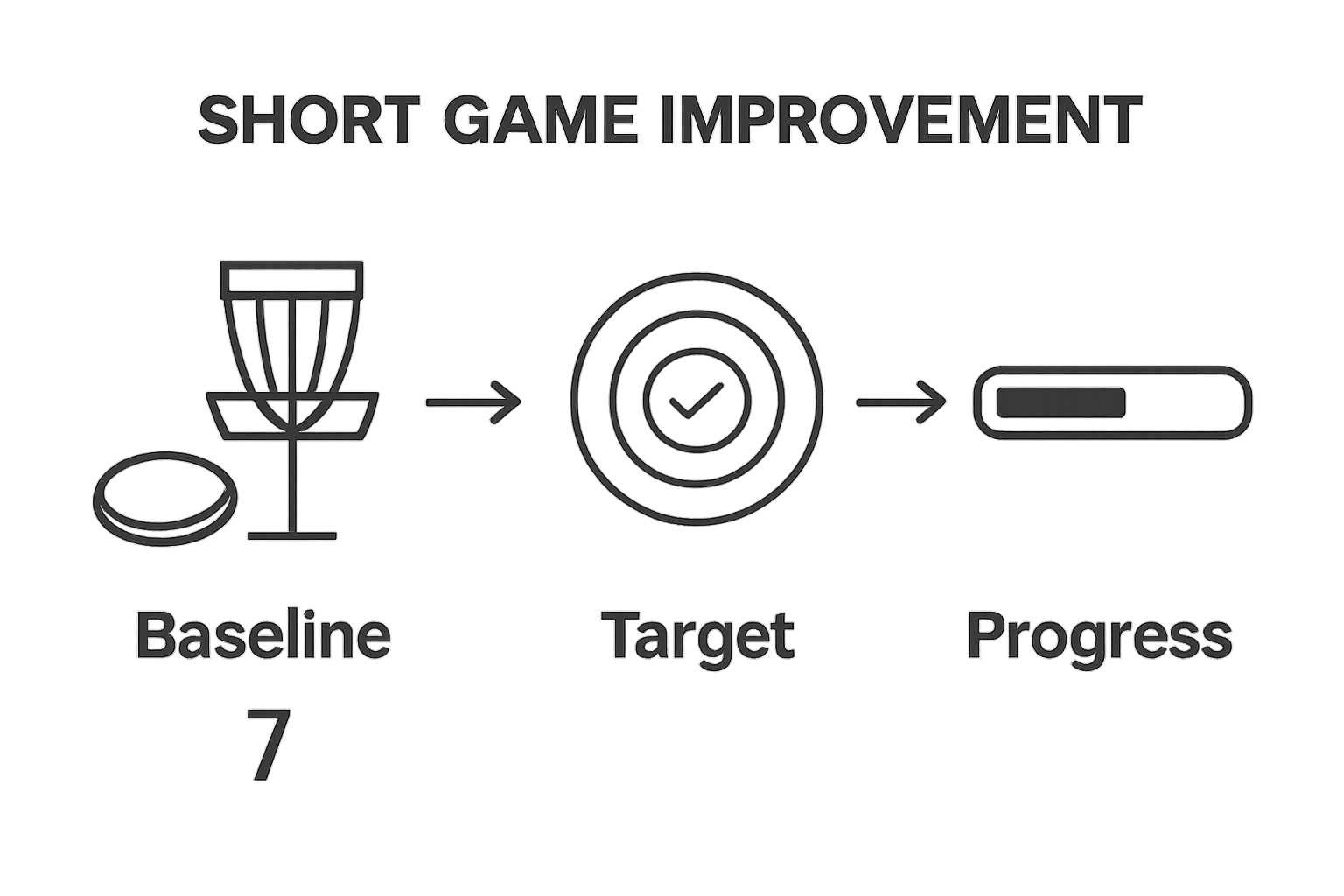
Your goals should challenge you without becoming overwhelming. Incremental improvement is the key to sustainable skill enhancement. For instance, aim to improve your putting accuracy by 5% every two weeks rather than expecting a dramatic 30% jump immediately. This measured approach prevents frustration and supports consistent skill building. Our guide on disc golf throwing techniques can provide additional insights into developing realistic improvement strategies.
Remember that goal setting is not a one-time event but an ongoing process. Schedule monthly reviews of your objectives, adjusting them based on your actual progress and emerging skills. Some goals might need modification as you develop, and that’s perfectly normal. The most successful disc golfers maintain flexibility while staying committed to continuous improvement. Your goals should serve as a motivational compass, guiding your practice sessions and keeping you focused on steady, meaningful advancement in your short game skills.
The following table provides an overview of typical short game improvement steps, estimated time commitments, and key outcomes to help you stay organized and focused.
| Step | Estimated Time | Key Outcome/Focus |
|---|---|---|
| Assess Short Game Skills | 30-45 minutes | Establish baseline skill and key improvement areas |
| Set Clear Improvement Goals | 15-30 minutes | Define measurable and achievable short game goals |
| Develop Practice Routine | 10-20 minutes (setup) | Plan consistent and intentional practice sessions |
| Execute Targeted Drills | 60-90 minutes per session | Build muscle memory and technique via repetition |
| Evaluate Performance | 15-30 minutes | Track, analyze, and visualize progress |
| Adjust and Refine Technique | Ongoing | Fine-tune mechanics based on data and feedback |
Step 3: Develop a Practice Routine
A structured practice routine transforms sporadic throwing attempts into purposeful skill development for your disc golf short game. Consistency and intentionality are the cornerstones of effective practice, turning raw potential into refined technique. Our beginner disc golf tips can provide additional context for developing a robust training approach.
According to practice performance research, establishing a preperformance routine significantly enhances skill execution. Design a practice session that mimics real game scenarios, focusing on specific skills identified during your initial assessment. Allocate 60-90 minutes per practice session, dividing time strategically: 30 minutes on putting accuracy, 30 minutes on approach shots, and 15-30 minutes analyzing and refining technique.
Equip your practice area with clear markers and multiple target points to simulate diverse course challenges. Use cones or visible landmarks to create different throwing distances and angles. Practice from various terrains – flat ground, slight inclines, and uneven surfaces – to develop adaptable short game skills.
Incorporate resistance and variability into your routine to prevent muscle memory from becoming too rigid.
Technology can dramatically enhance your practice effectiveness. Record video of your throwing techniques, allowing for detailed self-analysis. Review footage to identify subtle form inconsistencies, release points, and body mechanics that might impact your short game precision. Compare your recordings against professional disc golf technique videos to understand optimal form and movement patterns.
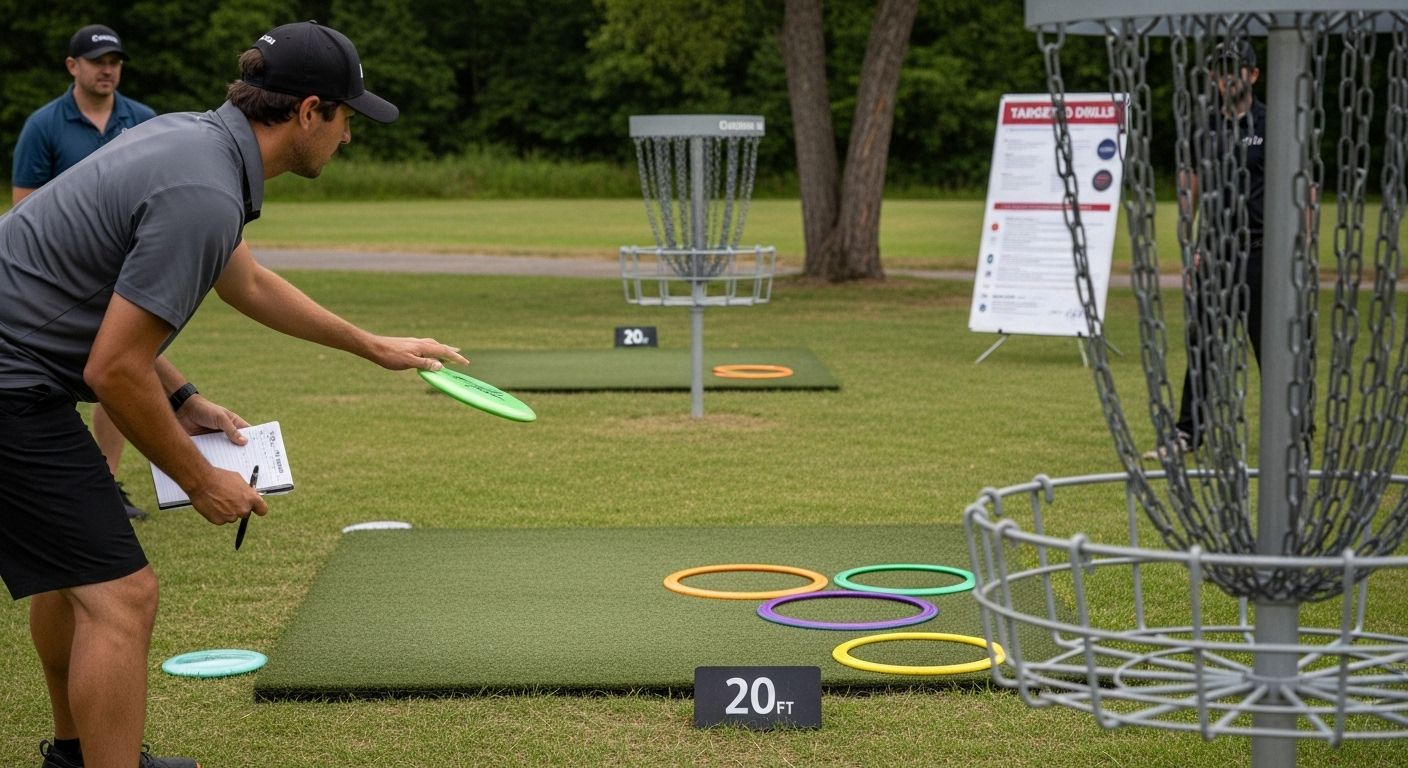
Develop a tracking system to monitor your progress systematically. Create a practice log that records daily performance metrics, including successful put percentages, approach shot accuracies, and technique observations. This documentation transforms your practice from random attempts into a structured improvement pathway.
Below is a table summarizing essential tools and resources mentioned throughout the article to support your disc golf short game improvement.
| Tool/Resource | Purpose | How to Use |
|---|---|---|
| Practice Basket | Target for putting and approach practice | Use in a dedicated area to simulate game scenarios |
| Discs (Putters/Approach) | Improve precision and control in short game shots | Select discs suited to your putting and approach technique |
| Cones/Markers | Mark distances and create drill boundaries | Place at key spots to guide practice drills |
| Smartphone/Video Camera | Record practice and analyze technique | Film practice sessions for form review |
| Practice Journal/Spreadsheet | Track progress, accuracy, and goal achievement | Log metrics after each practice session |
| Performance Tracking App | Systematically monitor multiple short game metrics | Use to visually review and analyze data over time |
| External Feedback (Coach/Group) | Provide expert technique insights and motivation | Join groups or consult a coach for feedback |
Step 4: Execute Targeted Drills
Targeted drills transform general practice into precise skill enhancement for your disc golf short game. Intentional repetition with strategic variation is the key to developing muscle memory and technical precision. Explore our disc golf throwing techniques to complement these drill strategies.
According to research on motor skill development, game-based learning approaches can significantly improve tactical awareness and skill execution. Design your drill sequence to simulate real course scenarios, focusing on specific challenges identified during your initial skill assessment. Create a progression that starts with fundamental techniques and gradually increases complexity.
Begin with the circle of confidence drill for putting accuracy. Place markers at different distances around a target basket – 10, 15, 20, and 25 feet – and attempt 10 consecutive puts from each marker. Track your success rate, requiring a minimum of 7 out of 10 puts before advancing to the next distance. This drill builds muscle memory and develops consistent release mechanics while providing measurable progress tracking.
For approach shot improvement, develop the obstacle navigation drill. Set up multiple obstacles like trees, cones, or elevated targets that force you to modify your throwing angle and trajectory. Practice forehand and backhand approaches, focusing on disc control and precise line selection. Randomly change obstacle configurations to prevent your technique from becoming too predictable. Incorporate uneven terrain to simulate real course challenges and enhance your adaptability.
Utilize video recording as a critical analysis tool during these drills. Capture your throwing motion from multiple angles, allowing you to identify subtle form inconsistencies. Compare your technique against professional disc golfers, paying attention to body positioning, release point, and follow-through. Review your recordings weekly, using insights to refine your drill approach and address specific technical weaknesses in your short game performance.
Step 5: Evaluate Your Performance
Performance evaluation transforms your disc golf short game improvement from guesswork into a strategic, data-driven process. Objective measurement is the key to understanding your true skill progression. Check out our beginner disc golf tips to complement your performance tracking approach.
According to research on disc golf performance tracking, technology and systematic recording methods can significantly enhance skill development. Develop a comprehensive performance tracking system that goes beyond simple score recording. Create a detailed spreadsheet or utilize a specialized disc golf performance tracking application that allows you to log multiple performance metrics.
Your performance evaluation should encompass several critical dimensions. Track putting accuracy by recording successful attempts at different distances, noting percentages and identifying consistent challenges. Measure approach shot precision by documenting throw distances, line accuracy, and landing proximity to target zones. Include qualitative observations about your technique, mental state, and physical comfort during throws. Quantitative data combined with subjective insights provides a holistic performance assessment.
Implement a monthly review process where you comprehensively analyze your tracked performance data. Look for emerging patterns, such as consistent accuracy drops at specific distances or recurring technical issues in your throwing mechanics. Compare your current performance against the baseline established in your initial skill assessment. Celebrate incremental improvements while identifying specific areas requiring focused attention in your next practice cycle.
Utilize visual representation techniques to make your performance data more engaging and comprehensible. Create graphs tracking your putting accuracy, approach shot success rates, and overall short game consistency. Color-code your performance metrics to quickly identify strengths and improvement areas. This visual approach transforms raw data into an actionable roadmap for continuous short game skill enhancement, keeping you motivated and strategically focused on your disc golf improvement journey.
Step 6: Adjust and Refine Your Technique
Technique refinement represents the critical intersection between data-driven insights and physical skill development in your disc golf short game journey. Continuous micro-adjustments transform good players into exceptional performers. Explore our comprehensive throwing techniques guide to support your technical evolution.
According to motion analysis research, precise physical mechanics can dramatically improve disc launch characteristics. Begin by identifying the most subtle aspects of your throwing technique revealed through your performance evaluation. Focus on granular elements like thumb placement, grip pressure, shoulder rotation, and weight transfer during your throwing motion.
Develop a systematic approach to technique modification that prevents overwhelming yourself with multiple changes simultaneously. Select one specific technical element to refine during each practice session. For instance, concentrate exclusively on your grip stability during one week, then transition to exploring your release angle in the subsequent week. This methodical progression allows your muscle memory to adapt incrementally without creating technical confusion.
Recording and analyzing video footage becomes an essential tool in your technique refinement process. Capture your throws from multiple angles – front, side, and rear perspectives – to provide comprehensive insight into your biomechanical movements. Compare your recorded technique against professional disc golfers, paying meticulous attention to nuanced differences in body positioning, arm extension, and follow-through mechanics. Slow-motion analysis can reveal technical subtleties invisible during real-time observation.
Establish a feedback loop that incorporates external perspectives to complement your personal observations. Consider working with a disc golf coach or joining local player groups where experienced athletes can provide targeted technical insights. Their trained eyes might identify technical nuances that your self-analysis might overlook. Remember that technique refinement is an ongoing journey of incremental improvements, requiring patience, consistent practice, and a willingness to challenge your existing muscle memory.
Transform Your Disc Golf Short Game With the Right Tools
You have worked hard to assess your skills, set goals and build a powerful practice routine. But even the best practice can be held back by outdated or ill-fitting discs and equipment. If you want to maximize your putting accuracy and approach shot control as described in this article, the right gear can make all the difference. Elevate every short game drill and track measurable gains with discs built for precision and confidence.

Ready to break through your skill plateau and make every stroke count? Visit GolfDiscs.com for high-quality disc golf discs and must-have equipment trusted by fellow enthusiasts. Take advantage of our expertise and find discs that support the techniques and drills you are perfecting. Do not let your game improvement stall. Get the gear you need today and feel the difference on your next round. Start exploring our full range now on GolfDiscs.com.
Looking for focused advice while refining your grip or throw? Pair your new discs with these essential disc golf throwing techniques to accelerate your mastery. Build an unstoppable short game foundation this season with solutions tailored for players at every level.
Frequently Asked Questions
How can I assess my short game skills in disc golf?
To assess your short game skills, practice putting from various distances (10, 20, and 30 feet) and track your successful shots to calculate your percentage accuracy. This self-assessment will help identify areas for improvement.
What goals should I set to improve my disc golf short game?
After assessing your skills, set specific, measurable goals, such as increasing your putting accuracy from 50% to 70% within two months. Break down your overall improvement into smaller targets that focus on distinct aspects like putting consistency and approach shot accuracy.
What should my practice routine include for short game improvement?
A structured practice routine should include 60-90 minutes of focused practice, dividing time between putting accuracy and approach shots, and incorporating both drilling techniques and live simulation. Consistency and intentionality are key to effective improvement.
How can I refine my throwing technique for better performance?
To refine your throwing technique, focus on one specific element (like grip stability or release angle) during each practice session. Use video analysis to compare your technique with professional players and make incremental adjustments based on your performance evaluations.