
0

Disc Golf Disc Numbers: Complete Guide
Did you know that nearly every disc golf disc is labeled with a unique set of four numbers? These flight ratings hold the key to understanding how a disc will fly before you even step onto the course. For both beginners and seasoned players, mastering what these numbers mean can be the difference between unpredictable throws and consistent shots. Unlocking this knowledge helps you match your discs to your style, leading to real improvements in control and distance.
Table of Contents
- Define Flight Rating Numbers (Speed, Glide, Turn, Fade)
- Explain How Ratings Relate To Disc Types
- How Numbers Reflect Disc Flight Behavior
- Factors Affecting Real‑World Flight Numbers
- Choosing Discs Based On Your Skill Level
- Common Misconceptions And Mistakes
Key Takeaways
| Point | Details |
|---|---|
| Understanding Flight Ratings | Disc golf discs are characterized by four flight ratings: Speed, Glide, Turn, and Fade, each indicating specific performance aspects. |
| Disc Type Correlation | Discs are categorized by speed ratings, influencing their characteristics; beginners should start with lower speed discs for better control. |
| Real-World Variability | External factors like wind, player technique, and disc wear can significantly affect a disc’s actual flight performance. |
| Skill-Based Selection | Discs should be matched to a player’s skill level, progressing from stable, lower-speed discs for beginners to high-speed discs for advanced players. |
Define Flight Rating Numbers (Speed, Glide, Turn, Fade)
Every disc golfer needs to understand the four critical flight rating numbers that describe a disc’s performance. According to PDGA, these numbers provide a standardized way to communicate a disc’s expected flight characteristics before you even throw it.
The four flight rating numbers represent Speed, Glide, Turn, and Fade, each measuring a specific aspect of the disc’s aerial behavior. Innova Discs explains these numbers typically range across different scales:
- Speed: Ranges from 1 to 14, indicating how fast the disc must be thrown to perform optimally
- Glide: Ranges from 1 to 7, measuring the disc’s ability to maintain altitude during flight
- Turn: Ranges from +1 to -5, describing the disc’s initial rightward movement during high-speed flight (for right-handed backhand throws)
- Fade: Ranges from 0 to 5, indicating how sharply the disc will hook left at the end of its flight
Understanding these numbers allows disc golfers to select discs that match their throwing style and skill level. A beginner might prefer discs with less extreme turn and fade ratings, while advanced players can leverage more complex flight characteristics to execute specific shots and techniques.
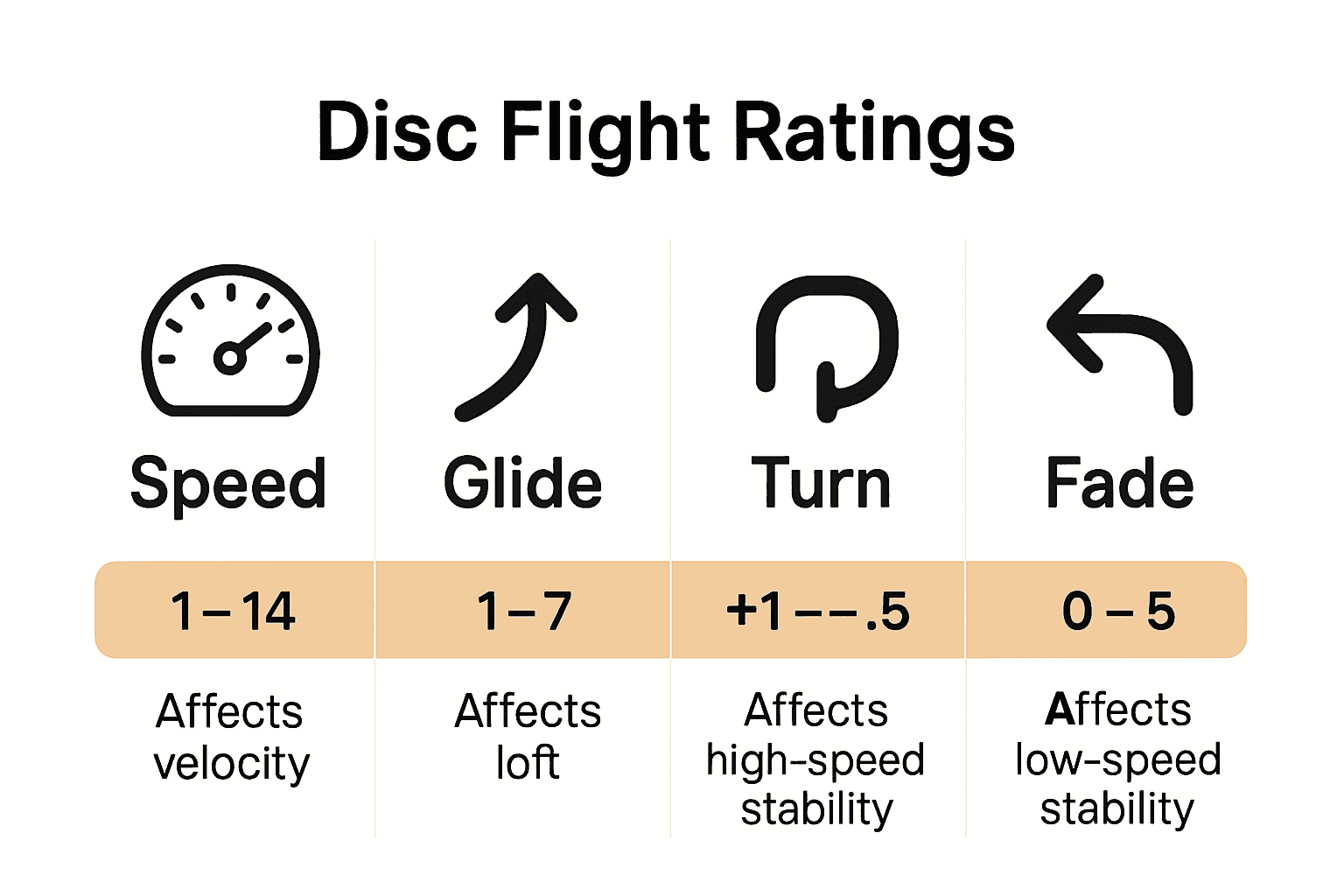 Check out our guide on understanding disc golf flight numbers for an even deeper dive into how these ratings impact your game.
Explain How Ratings Relate To Disc Types
Understanding how disc ratings connect to different disc types is crucial for selecting the right equipment in disc golf. PDGA provides a clear breakdown of disc types based on their speed ratings, which helps players match their skill level and throwing technique with appropriate discs.
Innova Discs explains that disc types are fundamentally categorized by their speed ratings:
Here’s a summary of how flight rating numbers relate to disc types:
| Disc Type | Typical Speed Rating | Common Characteristics |
|---|---|---|
| Putter | 1-3 | Short range High control |
| Midrange | 4-5 | Balanced control Moderate distance |
| Fairway Driver | 6-8 | Increased distance Steady flight |
| Distance Driver | 9-14 | Maximum speed Requires more skill |
- Putters (Speed 1-3): Designed for short, precise shots near the basket
- Midrange Discs (Speed 4-5): Offering a balance between control and distance
- Fairway Drivers (Speed 6-8): Providing more distance while maintaining reasonable control
- Distance Drivers (Speed 9-14): Engineered for maximum throw distance but requiring advanced throwing skills
As players progress in their disc golf journey, understanding these rating-based categories becomes increasingly important.
 Beginners should typically start with lower speed discs that are more forgiving and easier to control, while advanced players can leverage higher speed discs to execute more complex shots. Learn more about disc golf terminology with our comprehensive guide to help you navigate the nuanced world of disc selection and flight characteristics.
How Numbers Reflect Disc Flight Behavior
PDGA explains that flight numbers are more than just random digits—they’re a complex language describing a disc’s entire aerial journey. Each number reveals critical information about how the disc will behave from the moment it leaves your hand until it comes to rest.
Innova Discs breaks down how these numbers interact to predict flight characteristics:
- Speed determines the disc’s initial velocity requirement
- Glide indicates how long the disc will maintain altitude
- Turn shows the disc’s initial rightward movement
- Fade predicts the disc’s leftward hook at the end of its flight
Understanding these interactions is crucial for disc selection.
A disc with high speed but low glide will drop quickly, while a disc with high glide and minimal fade will have a more prolonged, gentle landing. Advanced players can manipulate these numbers to execute complex shots, using precise combinations of speed, glide, turn, and fade to navigate challenging course layouts. Check out our guide on disc golf flight paths to dive deeper into the nuanced world of disc trajectory and flight dynamics.
Factors Affecting Real‑World Flight Numbers
Innova Discs reveals that disc flight numbers are not absolute—they’re dynamic measurements that can change dramatically based on external conditions. Understanding these variables is crucial for disc golfers who want to predict and control their disc’s trajectory with precision.
According to PDGA, several key factors dramatically influence a disc’s real-world performance:
- Wind Conditions: Can significantly alter disc behavior
- Headwinds increase disc turn and reduce distance
- Tailwinds decrease turn and increase fade
- Player Technique: Throwing speed and release angle impact flight
- Disc Wear: Repeated use changes disc’s inherent characteristics
- Environmental Factors: Altitude and temperature affect aerodynamics
Experienced players learn to adapt their throws based on these variables, understanding that a disc’s printed flight numbers are more of a baseline than a guarantee. Your throwing technique, the disc’s condition, and environmental conditions will always play a significant role in how a disc actually performs. Learn more about disc golf flight paths and their complexities to develop a more nuanced understanding of disc behavior.
Choosing Discs Based On Your Skill Level
PDGA emphasizes that disc selection is not a one-size-fits-all approach, but a strategic process that evolves with a player’s developing skills. Your ability to control and predict disc flight is directly linked to choosing the right equipment for your current skill level.
Innova Discs recommends the following progression for disc selection:
- Beginner Level: Focus on discs with speed ratings 1-5
- Prioritize discs with higher glide
- Choose more stable, predictable flight characteristics
- Intermediate Level: Explore discs with speed ratings 6-8
- Develop more nuanced throwing techniques
- Experiment with slight turn and fade variations
- Advanced Level: Challenge yourself with speed ratings 9-14
- Master complex throwing techniques
- Leverage advanced disc flight dynamics
Progressively challenging yourself with increasingly complex discs allows for steady skill development. As your throwing power, accuracy, and understanding of disc dynamics improve, you’ll naturally gravitate towards more advanced disc selections. Check out our guide on how to choose disc golf discs to refine your selection strategy and maximize your disc golf potential.
Common Misconceptions And Mistakes
Innova Discs reveals that disc golf beginners often fall into predictable traps when interpreting flight numbers, leading to frustration and suboptimal performance. Understanding these common misconceptions can dramatically improve your disc selection and throwing technique.
PDGA highlights several critical misunderstandings about disc flight numbers:
- Speed Isn’t Everything
- Higher speed doesn’t guarantee longer throws
- Requires matching player’s arm speed and technique
- Overlooking Glide and Stability
- Flight numbers are interconnected
- Speed is just one part of the total flight characteristics
- Ignoring Disc Wear
- Discs change performance over time
- Initial flight numbers are not permanent
- Misunderstanding Turn and Fade
- These numbers predict complex flight paths
- Not simple linear measurements
Mastering disc selection requires looking beyond simple speed ratings and understanding the nuanced interplay of all flight characteristics. Explore our beginner disc golf tips guide to develop a more sophisticated approach to disc selection and throwing technique.
Master Your Disc Selection with Confidence
Choosing the perfect disc golf disc can feel overwhelming with all the flight rating numbers like speed, glide, turn, and fade to consider. If you have felt stuck trying to decode these ratings or frustrated by discs that do not match your throwing style, you are not alone. Many players struggle to find discs that suit their skill level and course conditions, making every throw a challenge instead of fun.

Take control of your game by exploring our extensive collection of discs designed for all skill levels and flight preferences at GolfDiscs.com. Whether you want putters with reliable control, midranges that balance glide and accuracy, or distance drivers built for powerful throws, our selection is crafted to help you improve quickly. Start transforming your disc golf experience now by visiting the complete disc golf disc selection and learn how to apply flight numbers to find your perfect match. Don’t wait—unlock your potential with the right discs today!
Frequently Asked Questions
What do the flight rating numbers on disc golf discs mean?
The flight rating numbers represent four key aspects of a disc’s performance: Speed, Glide, Turn, and Fade. Speed indicates how fast the disc must be thrown, Glide measures its ability to stay in the air, Turn describes its initial rightward movement (for right-handed backhand throws), and Fade indicates the leftward hook at the end of its flight.
How do I choose the right disc based on my skill level?
Beginners should start with discs that have speed ratings of 1-5, focusing on those with higher glide and stable flight characteristics. Intermediate players can explore discs with speed ratings of 6-8, while advanced players may challenge themselves with discs rated 9-14 for maximum distance and complex flight dynamics.
How does wind affect the flight of a disc golf disc?
Wind can significantly alter a disc’s behavior. Headwinds can cause the disc to turn more and reduce its distance, while tailwinds may decrease turn and increase fade. Understanding how to adapt to wind conditions is important for controlling disc trajectory.
What common misconceptions do beginners have about disc golf flight numbers?
Many beginners mistakenly believe that higher speed ratings guarantee longer throws without considering the importance of Glide, stability, and the interplay of Turn and Fade. It’s crucial to understand that all these numbers impact how a disc will perform in real-world conditions.